


Apify is a great web scraping platform to help you extract data at scale and reliably. That said, Apify comes with some limitations that make it not suitable for all web scraping projects and use cases.
If you’ve been looking for some Apify alternatives, this guide can help you make an informed decision. We’ll look at the 12 best Apify alternatives for web scraping in 2026. They’re compared based on their feature similarities to Apify, unique web scraping capabilities, and pricing.
Web Scraping Limitations of Apify
Apify is a powerful tool, but it has its challenges:
- Complexity: Apify can be hard to navigate for beginners.
- Pricing: The pricing structure might not suit smaller businesses.
- Features: You might need more specialized features or simpler workflows.
If you’re facing these challenges, exploring alternatives will help you find a tool that better matches your requirements.
Factors to Consider When Choosing Apify Alternatives
-
- Ease of Use: Look for a tool that matches your technical skills
- Pricing: Ensure the tool fits your budget
- Scalability: Consider how well the tool handles large projects
- Features: Identify features critical for your use case
- Support: Reliable customer support can save you time and headaches
ScraperAPI: The Best Apify Alternative in 2026

ScraperAPI is an all-in-one solution for web scraping, offering unmatched features and ease of use compared to Apify. Designed to simplify the web scraping process while providing scalability and cost efficiency, ScraperAPI excels in areas where Apify falls short.
Why ScraperAPI is The Best Apify Alternative
Advanced Proxy Handling:
- ScraperAPI uses AI-driven machine learning and statistical analysis to optimize proxy usage, ensuring requests are routed intelligently. This reduces overhead costs and enhances success rates.
- Unlike Apify, which requires manual setup for proxy handling, ScraperAPI automates the entire process, saving you time and effort.
Scalability for High-Volume Scraping:
- ScraperAPI’s Async Scraper feature is built for large-scale data extraction, handling millions of requests concurrently without performance bottlenecks.
- Apify offers scalability but lacks the dedicated asynchronous capabilities that ScraperAPI provides for seamless high-volume scraping.
Automated Data Pipelines:
- With DataPipeline endpoints, ScraperAPI enables users to schedule recurring scraping jobs, eliminating the need for constant manual intervention.
- Apify workflows require more setup time, and their automation options aren’t as intuitive or robust as ScraperAPI’s.
Ease of Integration:
- ScraperAPI’s straightforward API design allows developers to integrate it with Python, JavaScript, or other languages in minutes.
- While Apify supports similar integrations, its learning curve is steep for beginners, making ScraperAPI the more user-friendly option.
Pricing Advantage:
- ScraperAPI’s pricing starts at $49/month, making it accessible to small businesses and individual developers.
- Apify’s pricing starts at $49/month, but costs escalate quickly depending on the usage tier.
Built-in Anti-Bot Measures:
- ScraperAPI handles captchas, JavaScript rendering, and IP bans seamlessly, ensuring uninterrupted scraping.
- Apify users often rely on third-party tools or custom configurations for similar functionalities.
See the full feature comparison between ScraperAPI and Apify.
Pros and Cons of ScraperAPI
| Pros | Cons |
| AI-optimized proxy handling | Limited UI for no-code users |
| High scalability for large data volumes | |
| Affordable pricing structure | |
| Seamless integration with popular tools | |
| Automated scraping pipelines |
Pricing of ScraperAPI
ScraperAPI and Apify have similar pricing structures; the major notable differences are the increase in Apify’s price for higher plans and the lack of a detailed description of what each plan comes with, unlike ScraperAPI, which has a transparent pricing system and can be seen at a glance.
Apify is priced per compute unit (CU), calculated by multiplying the amount of memory (GB) allocated by the length of time it runs: ‘1 compute unit = 1 GB memory x 1 hour’. In contrast, ScraperAPI is priced per API credit, and for the lowest price, you get access to 10,000 API credits, equivalent to 20,000 e-commerce pages of data. There are no straightforward ways to calculate the number of pages a CU can get you.
| Plan | Price |
| Hobby | $49 |
| Startup | $149 |
| Business | $299 |
Other 11 Notable Apify Alternatives for 2026
1. Bright Data

Features:
- Large proxy pool for various use cases
- Supports market research, ad verification, and more
- Compatible with headless browsers
- Advanced IP rotation and targeting options
Pros and Cons:
| Pros | Cons |
| Extensive proxy network | Expensive for small-scale projects |
| Reliable customer support | Steep learning curve |
| Flexible plans for enterprise users |
Pricing:
Bright Data is priced per GB and Starts at $499/month, which is higher than Apify, making it less viable for smaller businesses or individuals. Apify is priced per compute unit, and the cost varies depending on your subscription. While Bright Data focuses more on proxies and large-scale scraping, Apify offers a broader range of automation tools.
| Plans | Price |
| Pay as you go | $8.4 / GB |
| Small | $499 monthly |
| large business | $999 monthly |
| Enterprise | $1999 monthly |
Trustpilot and G2 reviews
- Trustpilot review – 4.5 out of 5
- G2 review – 4.7 out of 5
Read more: Explore some of the best Bright Data alternatives.
2. Octoparse
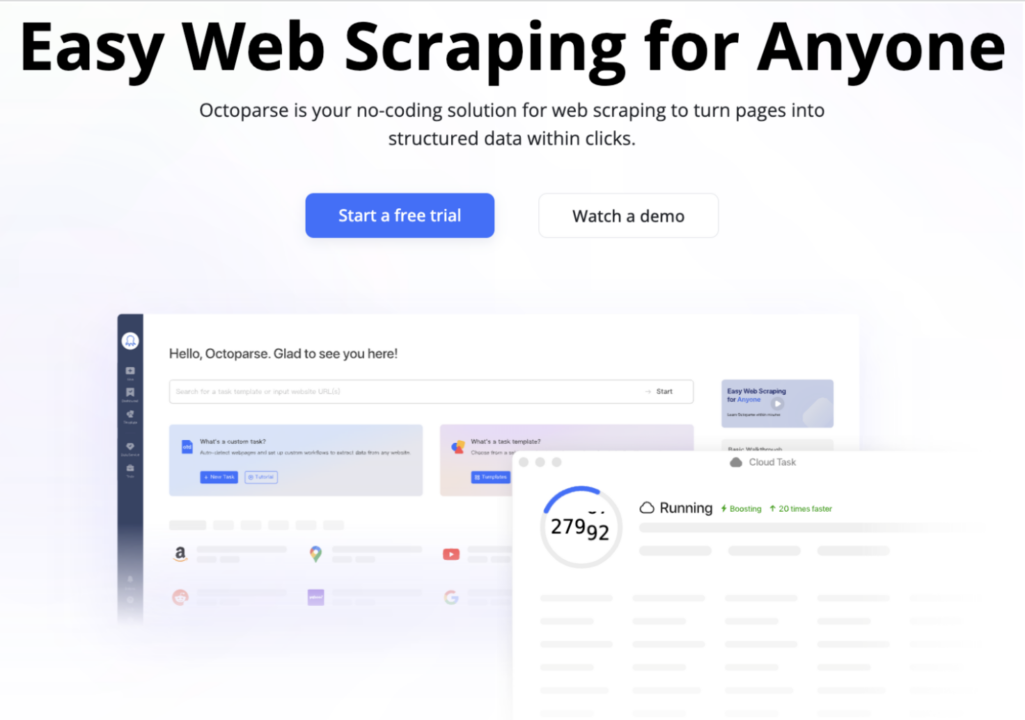
Octoparse is a no-code web scraping tool that simplifies data extraction for non-technical users. Its pre-built templates and visual interface make it an ideal choice for beginners and professionals looking for a user-friendly solution to collect and manage data efficiently.
Features:
- Drag-and-drop interface
- Predefined templates for common use cases
- Exports data in CSV, Excel, and JSON formats
- Cloud-based operation for seamless access
Pros and Cons:
| Pros | Cons |
| User-friendly for beginners | Limited scalability for large projects |
| Affordable pricing for small tasks | Slow data extraction on free plans |
| Excellent documentation |
Pricing:
Octoparse is a no-code web scraping tool; its price starts at $99 per month, costing a little more than Apify. Unlike Apify, Octoparse Is designed for non-developers who want a simple, user-friendly interface, positioning itself as a mid-tier solution. Octoparse has a stronger focus on simplicity and quick setup for basic scraping tasks, making it perfect for beginners.
| Plan | Price |
| Standard Plan | $99 |
| Professional Plan | $249 |
| Enterprise Plan | Custom |
Trustpilot and G2 reviews
- Trustpilot review – 2.9 out of 5
- G2 review – 4.3 out of 5
3. BrowserAct
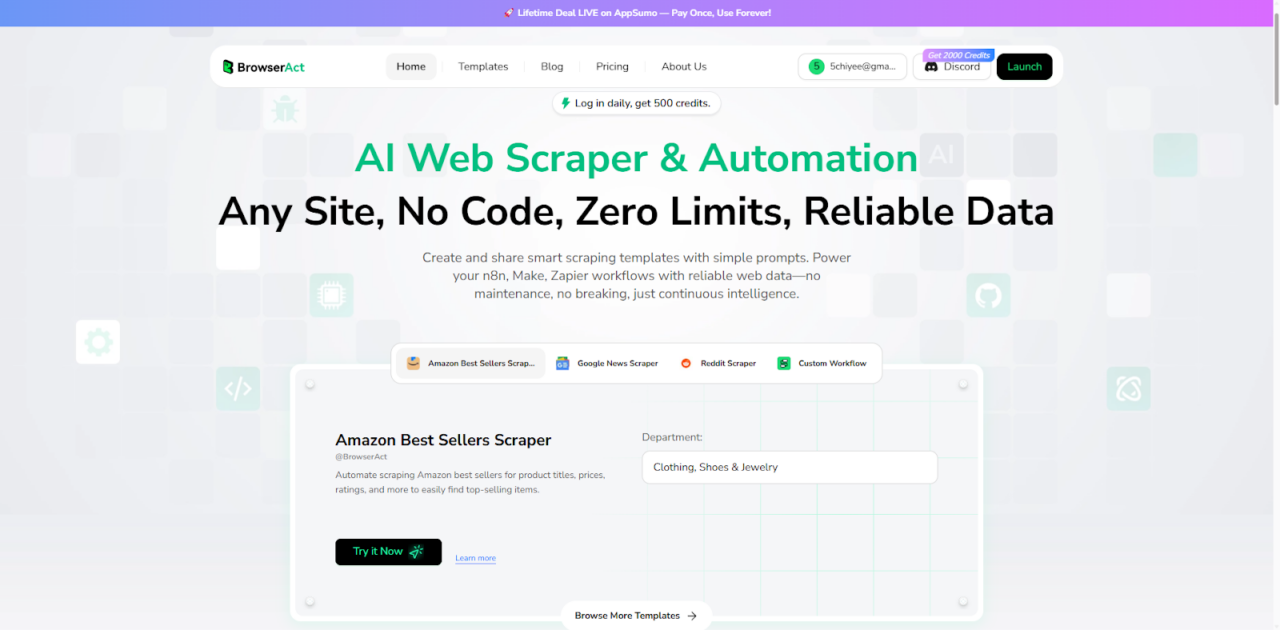
BrowserActis a cutting-edge, no-code AI web scraper that uses Artificial Intelligence to turn simple text prompts into powerful scraping & automation workflows. Its visual builder lets you create smart scraping templates by just describing what you want in plain English. Its visual builder allows you to construct precise scraping logic using dedicated components—such as Visit nodes for navigation and Extract Data nodes for capturing information. You simply configure these nodes, and the AI optimizes the execution, handling complex page interactions with very high accuracy. It also features a library of over 100 ready-to-use scraper templates, allowing you to start scraping popular sites instantly.
Features:
- No-code visual builder with drag-and-drop interface
- 100+ ready-to-use scraper templates for popular websites
- Control scraping logic using simple text prompts
- Automatically bypasses Cloudflare and CAPTCHAs
- Global IP coverage to access geo-restricted sites
- Seamless connection to automation platforms like n8n, Make, and Zapier
Pros and Cons:
| Pros | Cons |
| No coding required for complex tasks | Newer tool with fewer community reviews |
| Direct integration with automation platforms | Relies on AI interpretation of prompts |
| Huge library of pre-built web scraper templates | Execution time can be slower due to processing |
| High accuracy (99.8%) in data extraction |
Pricing:
BrowserAct is a no-code automation platform; its pricing model is designed to be flexible. Unlike traditional tools that charge high monthly subscriptions, BrowserAct focuses on value for modern automation stacks. It positions itself as a smart alternative to Apify for users who want to power tools like n8n, Make, and Zapier without maintaining complex code. It is perfect for those who want reliable web data without the headache of constant maintenance.
| Plan | Price |
| Free Trial | Free 500 credits/day |
| Pay as you go | $1 / 1000 credits |
Trustpilot and G2 reviews
- Trustpilot review – 4.0 out of 5
- G2 review – 4.8 out of 5
4. ParseHub
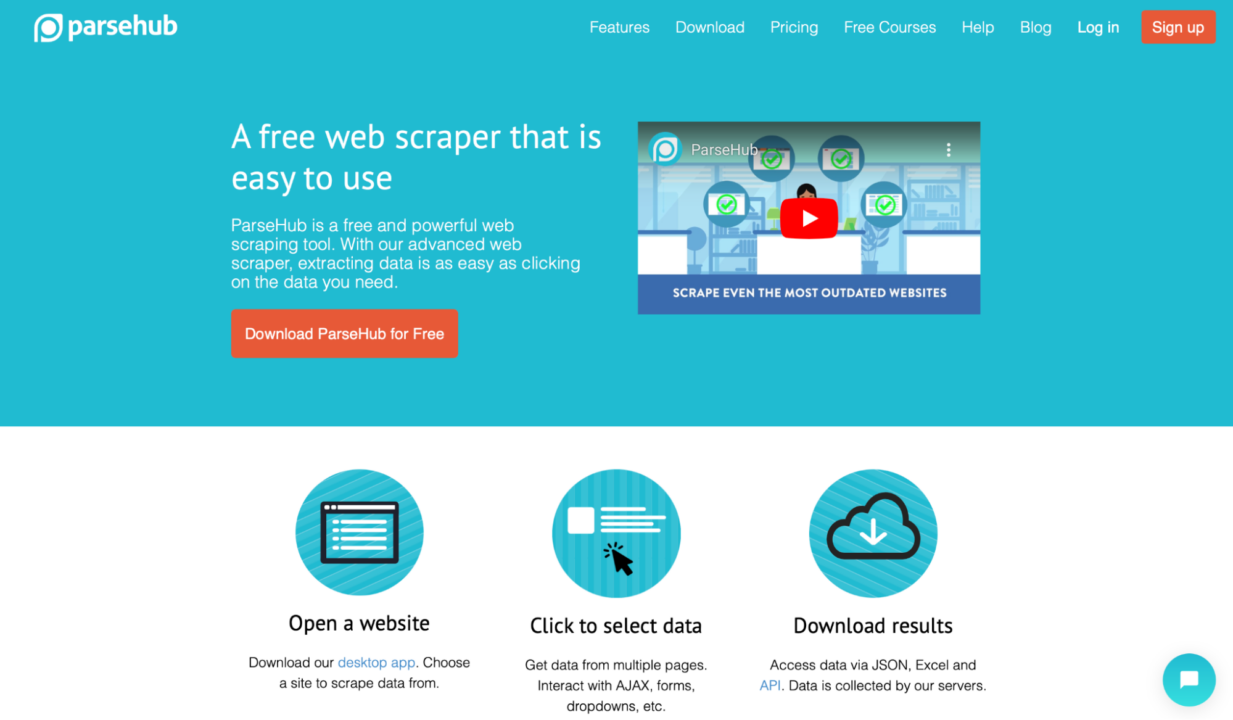
ParseHub provides a visual data extraction interface suitable for complex scraping workflows. Its versatility with dynamic websites makes it a popular choice among technical users. With its intuitive visual interface, ParseHub allows you to create scraping workflows without requiring coding skills. It supports automation, scheduling, and multi-platform compatibility, making it ideal for technical and non-technical users.
Features:
- Works on dynamic websites
- Supports scheduling and automation
- Free plan available with limited features
- Multi-platform support for flexibility
Pros and Cons:
| Pros | Cons |
| Handles dynamic websites well | Limited support for concurrent tasks |
| Offers a free plan | |
| Supports advanced workflows |
Pricing:
ParseHub offers a free plan with limited features, but its paid plans can go up to $600 monthly. It provides powerful scraping capabilities for dynamic websites but is more expensive for smaller users. Compared to Apify, ParseHub is better for non-technical users due to its intuitive interface and stronger focus on handling JavaScript-heavy websites with minimal configuration. If price is your primary concern, Apify might be a better choice.
| Plan | Price |
| Standard | $189 |
| Professional | $599 |
| ParseHub Plus | Custom |
Trustpilot and G2 reviews
- Trustpilot review – 0.0 out of 5
- G2 review – 4.3 out of 5
Read more: Explore some of the best Parsehub alternatives.
5. PhantomBuster

PhantomBuster automates web scraping and social media data collection using APIs and workflows. With pre-built APIs and integrations for LinkedIn, Twitter, and other networks, PhantomBuster enables users to collect data, automate repetitive tasks, and export results in various formats. Its user-friendly interface and Zapier integration make it popular for marketers and growth hackers looking to streamline social media activities and data collection.
Features:
- Automates LinkedIn, Twitter, and other platforms
- Cloud-based with no installation needed
- Exports data in various formats
- Integrates with third-party automation tools like Zapier
Pros and Cons:
| Pros | Cons |
| Great for social media scraping | Limited features for broader scraping |
| Cloud-based and easy-to-use | Expensive for advanced workflows |
| Supports Zapier integration |
Pricing:
PhantomBuster specializes in social media scraping and automation, starting at $69 monthly. It is one of the more budget-friendly tools, particularly for users focused on social media-related tasks. PhantomBuster is a niche-focused scraping tool that automates workflows for platforms like LinkedIn, Instagram, and Twitter. Unlike Apify, it is specifically designed for lead generation, social media scraping, and automation tasks.
| Plan | Price |
| Starter | $69 |
| Pro | $159 |
| Team | $439 |
Trustpilot and G2 reviews
- Trustpilot review – 2.8 out of 5
- G2 review – 4.3 out of 5
6. Zyte (formerly Scrapinghub)
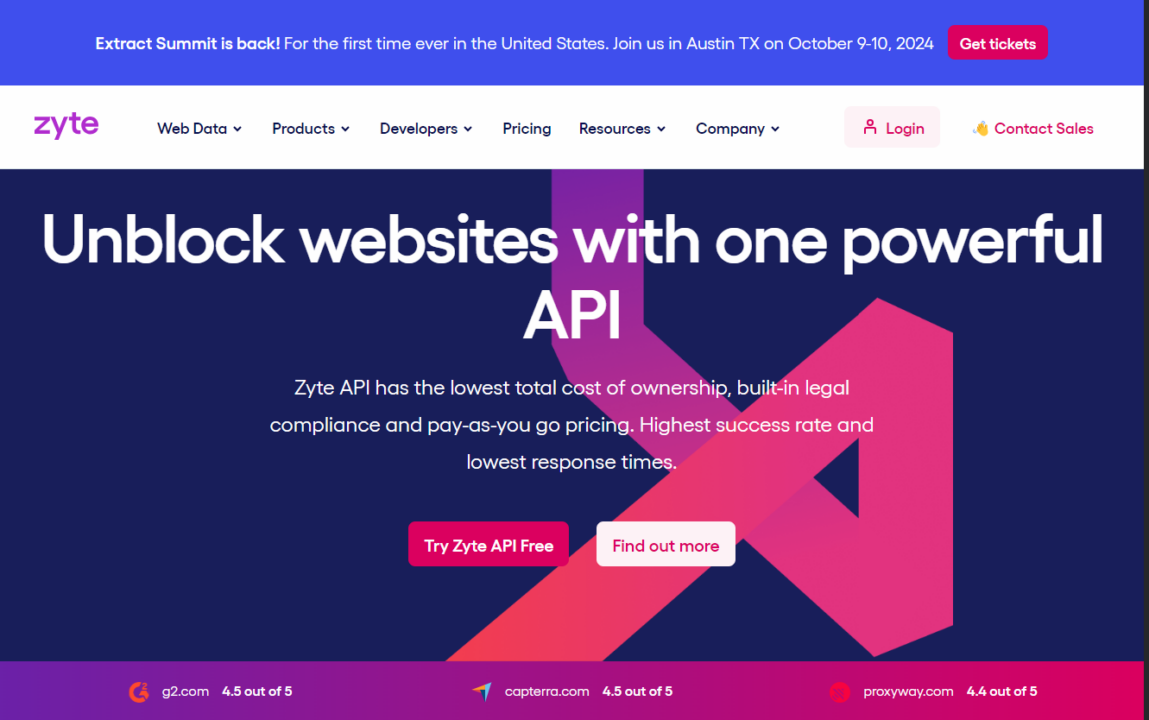
Zyte provides tools like Smart Proxy Manager and web scraping APIs for enterprise-grade data extraction. It simplifies the process of collecting structured data from the web, making it an excellent choice for companies with large-scale data needs, such as market research, price monitoring, and competitive analysis.
Features:
- Rotating proxies with anti-blocking capabilities
- Data-as-a-service offerings
- Supports Python-based Scrapy framework
- Customizable tools for specific needs
Pros and Cons:
| Pros | Cons |
| Excellent proxy management | Expensive for small-scale users |
| Wide range of tools for developers | Requires technical expertise |
| Wide range of tools for developers |
Pricing:
Zyte has a lot of packages, so it is best to contact Zyte’s team for a price for your project. On the website, Zyte’s pricing begins at $450 per month, making it expensive for small and medium businesses, unlike Apify, which is affordable and suitable for small and large businesses. Zyte offers a managed scraping service, automatic extraction, and proxy management at its price point. It is designed for enterprise-level scraping, focusing on large-scale, high-complexity projects with little user effort. So, if the scale of your project is large, Zyte might be a good option.
| Plan | Price(Starting at) |
| Custom | $450/month |
| Standard | $450/month |
Trustpilot and G2 reviews
- Trustpilot review – 2.0 out of 5
- G2 review – 4.4 out of 5
Read more: Explore some of the best Zyte alternatives.
7. Scrapy
Scrapy is an open-source web scraping framework for developers familiar with Python. Its flexibility and extensive libraries make it ideal for large-scale and complex projects. Its modular design and extensive documentation suit everything from small projects to large-scale scraping workflows.
Features:
- Highly customizable for complex projects
- Supports integrations with middleware and pipelines
- Free to use but requires setup
- Strong community support and regular updates
Pros and Cons:
| Pros | Cons |
| Completely free | Requires significant technical skills |
| Great for large-scale projects | No customer support |
| Active developer community |
Pricing:
Free
Trustpilot or G2 reviews
- Trustpilot review – Nill
- G2 review – Nill
8. Diffbot
Diffbot specializes in AI-powered data extraction and knowledge graph generation. It’s ideal for unstructured data extraction and machine learning applications. Diffbot uses natural language processing and computer vision to extract insights from websites, offering fully automated, customizable web scraping solutions without coding. Its API suite supports tasks like article extraction, product data scraping, and sentiment analysis, making it a go-to tool for enterprises looking to gather actionable data at scale.
Features:
- Extracts structured data from unstructured web content
- API integration for automated workflows
- Powerful for machine learning applications
- Knowledge graph generation for enhanced insights
Pros and Cons:
| Pros | Cons |
| AI-powered data extraction | Very expensive |
| Great for unstructured data | Limited no-code features |
| Integrates with ML workflows |
Pricing:
Diffbot is an AI-powered data extraction, starting at $299 per month, which makes it significantly more expensive than Apify and impractical for individuals with limited budgets. This premium pricing caters to users seeking advanced features like unstructured data extraction and knowledge graph creation for large-scale projects.
For context:
- Diffbot startup plan ($299): 250k API credits, equivalent to 250,000 pages (of any type) scraped. Click here for a more detailed explanation of credit deduction. There is no straightforward way to calculate the number of pages a CU can get you.
| Plan | Price |
| STARTUP | $299/Month |
| PLUS | $899/Month |
| ENTERPRISE | Custom |
Trustpilot or G2 reviews
- Trustpilot review – Nill
- G2 review – 4.9
Read more: Explore some of the best Diffbot alternatives.
9. Mozenda
Mozenda is a cloud-based web scraping tool tailored for business users. It provides a user-friendly interface for building and managing scraping workflows without requiring programming knowledge. Known for its business-oriented approach, Mozenda is ideal for extracting actionable insights from large-scale datasets, empowering users with automation and scalability for their data collection needs.
Features:
- Intuitive point-and-click interface
- Supports data export in multiple formats
- Cloud-based with scheduling capabilities
- Strong customer support for troubleshooting
Pros and Cons:
| Pros | Cons |
| Simple interface for business users | Lacks advanced proxy features |
| Supports various export formats |
Pricing:
Mozenda does not disclose its pricing publicly. Its plans are customized based on specific user requirements, making it a less transparent option than Apify. It is affordable and has transparent pricing, making it ideal for small and large-scale projects. Mozenda is another excellent choice for non-technical users, emphasizing simplicity and ease of use and offering enterprise-level support and managed services.
Trustpilot or G2 reviews
- Trustpilot review – Nill
- G2 review – 4.1
10. ScrapingBee
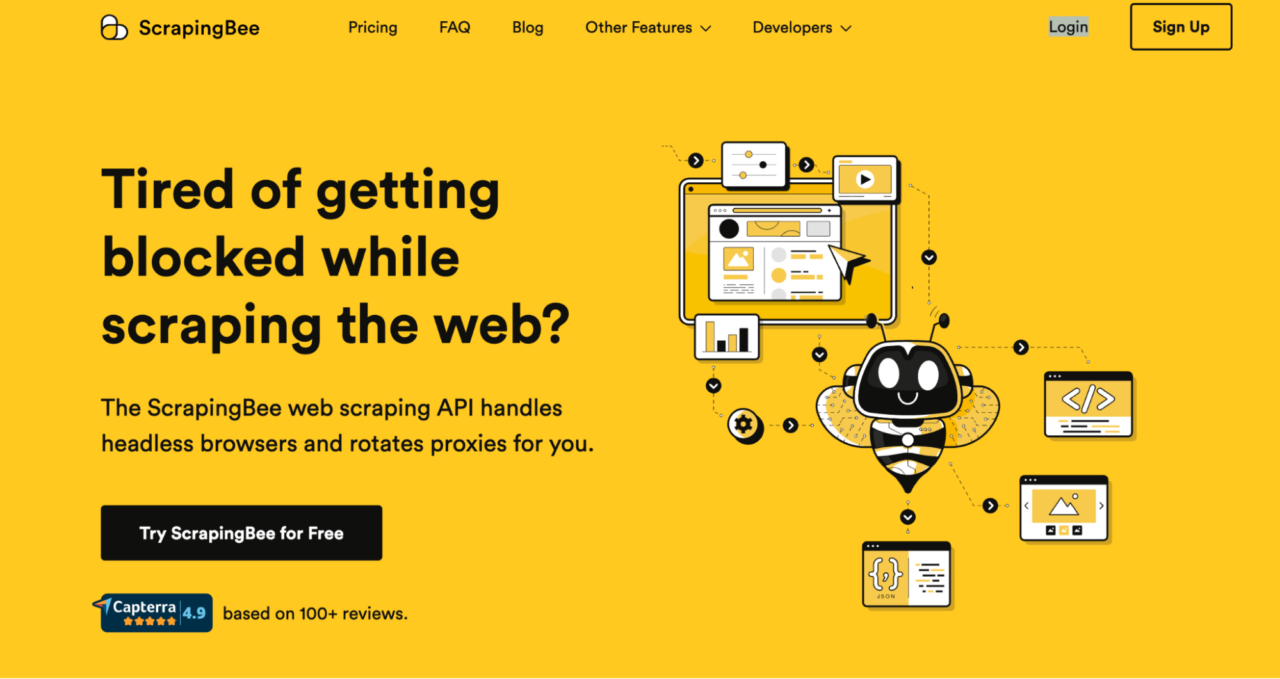
ScrapingBee is a developer-focused web scraping API designed to make data extraction seamless, especially from JavaScript-heavy websites. Its lightweight API enables users to focus on extracting clean, structured data without worrying about the complexities of rendering dynamic web pages. ScrapingBee focuses on providing a hassle-free scraping experience with integrated proxy management.
Features:
- Headless browser support
- Built-in proxy rotation
- Optimized for rendering JavaScript-heavy websites
Pros and Cons:
| Pros | Cons |
| Great for JavaScript-heavy websites | No free plan |
| Easy setup and integration | No clear concurrent thread limits per plan |
| Reliable proxy management |
Pricing:
ScrapingBee starts at $49 monthly, offering integrated proxy management and JavaScript rendering. It is a solid mid-range option for small to medium-sized scraping projects. ScrapingBee is better for simple API-based scraping, offering a straightforward solution for quick scraping tasks. It handles web scraping tasks (CAPTCHA) challenges automatically, making it ideal for developers who want a low-learning-curve tool. In contrast, Apify is more versatile, requires more setup, and offers greater functionality.
| Plan | Price/month |
| Freelance | $49 |
| Startup | $99 |
| Business | $249 |
| Business + | $599 |
Trustpilot or G2 reviews
- Trustpilot review – 0.0/5
- G2 review – 0.0/5
Read more: Explore some of the best ScrapingBee alternatives.
11. Lobstr.io
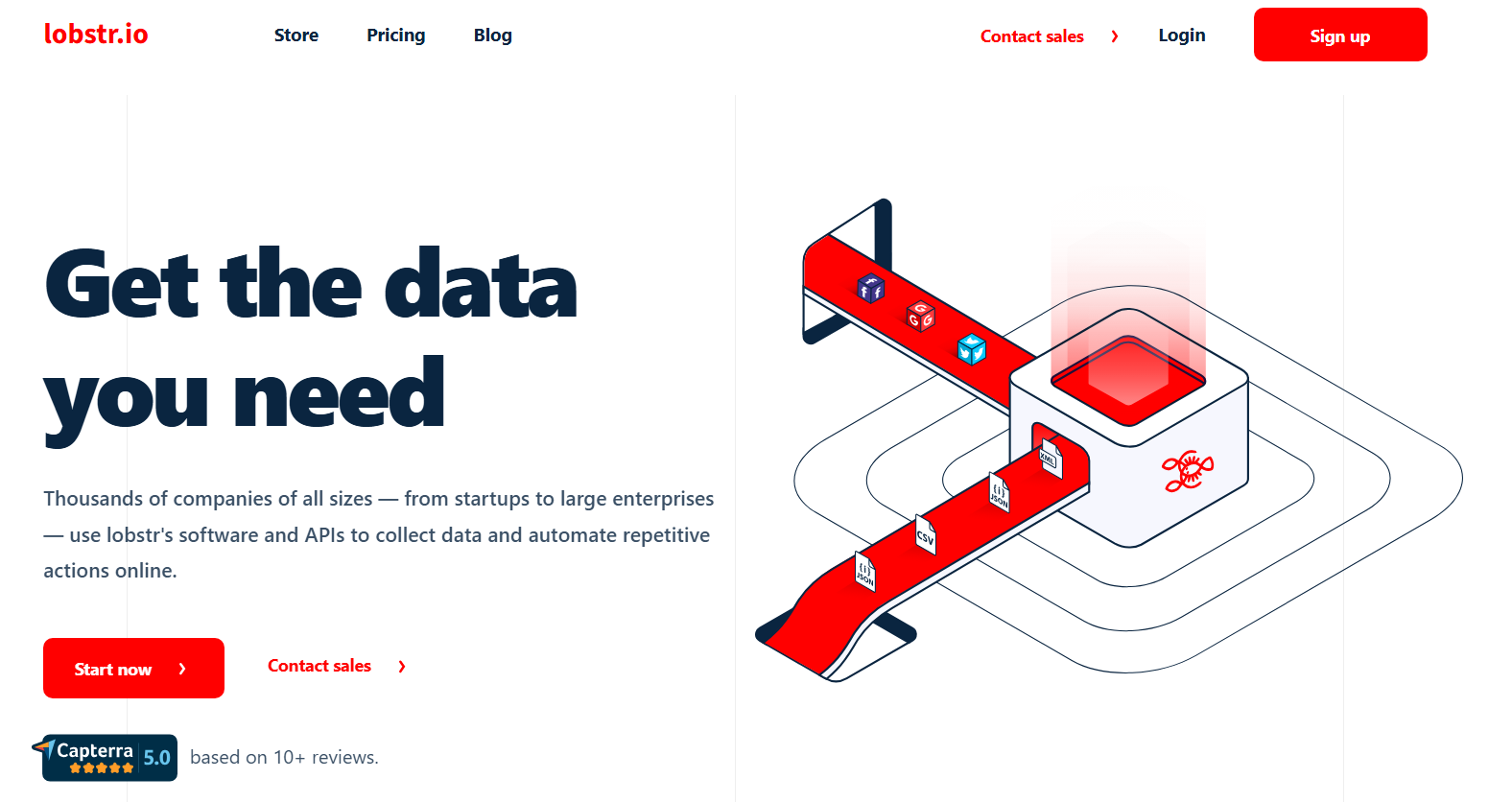
Lobstr.io offers a no-code web scraping platform and API built for speed, simplicity, and affordability. Its user-friendly tools make it popular among startups and small to medium businesses.
With powerful automation features, integrated email enrichment, and a developer-friendly API, Lobstr.io helps businesses collect and use public web data without the technical overhead.
Features:
- 20+ no-code web scraping tools
- Lead scraping tools with email validation and enrichment
- Schedule feature for continuous/automated data collection
- Direct export to Google Sheets, S3, SFTP, and other platforms
- Developer-friendly API
Pros and Cons:
| Pros | Cons |
| Scheduling feature | Fewer scrapers than Apify |
| Suitable for SMBs | No pay-as-you-go (yet) |
| Affordable pricing plans |
Pricing:
Lobstr.io generally costs around €0.025 per 1,000 rows. It offers monthly subscription plans starting at €50/month.
Unlike Apify, Lobstr.io uses a credit-based system — where credits are consumed per row, per email, or per extra data point.
You only pay for the data you get.
There are no rental or compute unit costs, which makes it more budget-friendly than Apify.
| Plan | Price/month |
| Free forever | €0 |
| Premium | €50 |
| Business | $250 |
| Enterprise | $500 |
Trustpilot or G2 reviews
- Trustpilot review – 4.1 out of 5
- Capterra review – 5 out of 5
Apify Alternatives Compared
| Products | Starting Price | Free Trial | Key Value | Why ScraperAPI is Better |
| Apify | $49/month | Yes | Feature-rich but complex | Simpler, more scalable APIs |
| ScraperAPI | $49 | Yes | All-in-one scraping solution with AI-optimized proxies | More affordable and efficient |
| Bright Data | $499 | Yes | Extensive proxy network | More cost-effective for most use cases |
| Octoparse | $99 | Yes | No-code interface | Scales better for large data needs |
| ParseHub | $189 | Yes | Visual workflows | Better proxy handling |
| PhantomBuster | $69 | Yes | Social media automation | Broader scraping capabilities |
| Zyte | $450 | No | Enterprise tools | Affordable for small-to-medium projects |
| Scrapy | Free | Free | Open source | Plug-and-play, easier to use |
| Diffbot | $299 | Yes | AI-powered extraction | More affordable |
| Mozenda | Custom pricing | Yes | Business-oriented interface | Better proxy management |
| ScrapingBee | $49 | No | JavaScript rendering | Broader features and scraping flexibility |
| Lobstr.io | $50 | Yes | No-code scrapers with task scheduling and lead data collection | ScraperAPI supports higher scale, broader feature set |
ScraperAPI is a Great Web Scraper Alternative to Apify
The best Apify alternative depends on your specific needs, but when evaluating alternatives to Apify, ScraperAPI stands out as the most effective solution for web scraping in 2026. Its affordability, ease of use, scalability, and advanced features set it apart from others.
Why ScraperAPI Stands Out from Other Apify Web Scraper Alternatives
The following key features make ScraperAPI the number one choice for businesses that are looking for another web scraping tool similar to Apify.
- Unmatched Pricing and Transparency
While many competitors, such as Bright Data and ParseHub, charge based on bandwidth or use complex pricing models, ScraperAPI’s straightforward credit-based system is transparent and predictable. For $49/month, you can send up to 100,000 API credits to scrape approximately 20,000 eCommerce pages, making it far more cost-effective than Apify or other tools like Zyte and Bright Data. - Scalability at Any Level
ScraperAPI is purpose-built to handle high-volume scraping tasks. Features like the Async Scraper and DataPipeline allow you to handle millions of requests simultaneously, schedule recurring jobs, and manage large-scale projects with minimal manual intervention. This scalability ensures it can grow with your needs, whether you’re a solo developer or managing enterprise-level projects. - AI-Optimized Proxy Handling
One of ScraperAPI’s features is its AI-driven proxy rotation system, which uses machine learning to optimize requests. This ensures higher success rates, reduces costs by only rotating proxies when necessary, and handles anti-bot measures like captchas and IP bans. ScraperAPI automates these tasks, unlike tools requiring manual configurations, saving time and effort. - Structured Data Endpoints (SDEs) for Cleaner Data
ScraperAPI’s SDEs simplify data cleaning and automation by delivering well-structured, ready-to-analyze data. This reduces the need for post-processing, enabling faster decision-making and smoother workflow integration. For businesses focused on efficiency, this is a game-changer. - Ease of Integration and Automation
With a developer-friendly API that integrates seamlessly with Python, JavaScript, and other programming languages, ScraperAPI eliminates the steep learning curve often associated with tools like Apify. Its built-in scheduling and automation tools make it easy to streamline scraping workflows without extensive technical expertise. - Reliability and Customer Support
Unlike some alternatives, ScraperAPI is supported by a dedicated team that proactively handles site changes and optimizes performance. This ensures consistently high success rates, giving users peace of mind even when scraping dynamic or highly-protected websites.
With its powerful features, transparent pricing, and focus on scalability and automation, ScraperAPI is the ideal alternative to Apify for 2026. Whether you’re extracting data for business intelligence, eCommerce, or research, ScraperAPI delivers the efficiency, flexibility, and affordability you need. It’s not just a tool; it’s a complete web scraping solution designed to help you quickly achieve your goals.
Based on this, ScraperAPI is your best choice for web scraping in 2026.
Happy Scraping!