
A rank tracker API, also called a rank tracking API, returns keyword positions from search results, and it comes in two forms. Platforms such as SE Ranking, AccuRanker, and Keyword.com track the keywords for you and store the history, and SERP APIs such as ScraperAPI, SerpWow by ScraperAPI, DataForSEO, and SerpApi return the raw results page, so you build the tracker yourself.
This guide compares ten of them on list prices, location targeting, AI Overview support, and G2 reviews, then shows what 1,000 keywords checked daily cost on each.
| Tool | Type | Best for | Entry price | Free trial or tier |
|---|---|---|---|---|
| ScraperAPI | Web data infrastructure with a Google SERP API | Developers and data teams that build their own tracker | $49 a month ($44.10 billed annually) for 100,000 credits, about 4,000 Google searches | 7-day trial, 5,000 credits, no card |
| SerpWow by ScraperAPI | Separate SERP API product with its own plans | Teams that need Bing, Yahoo, and city or ZIP targeting | $38 a month for 1,000 searches | Free trial |
| SE Ranking | Full SEO platform with a rank tracker and API | Agencies that want an all-in-one SEO suite | $129 a month for 2,000 daily keywords | 14-day trial, no card |
| AccuRanker | Rank tracking and LLM visibility for agencies and enterprises | Agencies and enterprises with large keyword counts | $249 a month for 2,000 keywords | Demo on request |
| Keyword.com | Keyword rank tracker for SEO visibility and AI search | Agencies that want API access on every plan | From $11 a month for 1,000 keywords updated weekly (API-only) | 14-day trial, 100 keywords, no card |
| DataForSEO | Google SERP API, pay-as-you-go | Developers who want the lowest price per SERP | $0.60 per 1,000 SERPs (Standard queue) | $1 trial credit |
| SerpApi | Real-time API to access Google search results | Developers who want a fixed monthly plan | $25 a month for 1,000 searches | 250 searches a month |
| Bright Data SERP API | Structured search results from Google, Bing, and other engines | High-volume, multi-engine collection | $1.50 per 1,000 successful requests | 5,000 requests a month, shared across its APIs |
| Scrapingdog | Web scraping API with a dedicated Google SERP API | Developers who want a low credit price | $40 a month for 200,000 credits | 100 credits, no card |
| Zenserp | Google SERP API | Teams that want AI Overview text and a batch endpoint in one API | $49.99 a month for 25,000 searches | 50 searches a month |
Best rank tracker APIs: Key takeaways
- Platforms with an API (SE Ranking, AccuRanker, Keyword.com) store the history and bill per tracked keyword, while SERP APIs bill per search and leave scheduling and storage to you.
- For 1,000 keywords checked daily on the first page of results, one location and one device, the SERP APIs in this guide cost between $18 a month (DataForSEO Standard queue) and $499 a month (SerpWow by ScraperAPI).
- ScraperAPI suits developers and data teams that build their own tracker and want the SERP, scheduling, and delivery from one vendor, at $149 a month ($134.10 billed annually) on Startup, which holds the 750,000 credits that 1,000 daily keywords need, but it stores no history.
- SerpWow by ScraperAPI is a separate SERP API with its own plans and billing, and it suits teams that need Bing, Yahoo, and city or ZIP targeting, from $38 a month for 1,000 searches, but it stores no history.
- SE Ranking suits agencies that want a rank tracker API inside a full SEO platform, from $129 a month, but API calls run on platform plans and keyword limits.
- AccuRanker suits agencies and enterprises that want read and write APIs, from $249 a month, but its Professional plan lists neither API.
- Keyword.com suits agencies that want API access on every plan with city and ZIP targeting, from $11 a month for 1,000 keywords updated weekly, but it tracks Google only for classic SERP tracking.
- DataForSEO suits developers who want the lowest price per SERP, $0.60 per 1,000 on the Standard queue, but they build the dashboard and storage themselves.
- SerpApi suits developers who want a fixed monthly plan with city-level location, from $25 a month, but it keeps search data for only 31 days and has no pay-as-you-go option.
- Bright Data suits high-volume, multi-engine collection at $1.50 per 1,000 successful requests, but G2 reviewers find the pricing hard to read and the learning curve steep.
- Scrapingdog suits developers who want a low credit price, from $40 a month, but G2 and Reddit reviewers report reliability and support concerns.
- Zenserp suits teams that want AI Overview text and a batch endpoint in one API, from $49.99 a month (batch starts on Medium at $149.99), but an AI Overview request costs three searches.
- A tracker needs a rank counter, a store, a validity check, and a schedule, and failed checks belong in the store as “missing”, never “unranked”.
- Choose a platform for dashboards and stored history, and a SERP API when you are building a product or a custom pipeline.
- The FAQs answer what a rank tracker is, what SERP tracking is, and which rank tracker or API suits SEO best.
What are the key features of a rank tracker API?
A Google rank tracker API returns where a URL appears for a keyword in a chosen country and on a chosen device. Some products return only the raw results page, so you calculate the rank yourself, while a keyword rank tracker API that stores history and bills per tracked keyword calculates it for you.
Four features separate one product from another, and each one changes the price you pay and the work you take on:
- Billing unit and list price: platforms charge per tracked keyword, DataForSEO per SERP of 10 results, Bright Data per 1,000 successful requests, and ScraperAPI, SerpWow by ScraperAPI, and Scrapingdog per credit.
- Location and device targeting: all ten support country targeting, but city and ZIP targeting differ. Keyword.com and SerpWow by ScraperAPI list ZIP targeting, DataForSEO and SerpApi accept coordinates, and Bright Data and Scrapingdog list city-level targeting. ScraperAPI’s Google SERP API targets countries, not cities. SerpWow by ScraperAPI is a separate product with its own plans and billing, and it targets down to ZIP and postal codes. Devices range from desktop and mobile to tablet and named operating systems.
- AI Overview and AI search: SE Ranking, AccuRanker, and Keyword.com track AI Overviews inside the platform. SerpApi, Scrapingdog, and Zenserp expose them as a separate call or parameter, and SerpWow by ScraperAPI adds them through
include_ai_overview. ScraperAPI’s AI Results endpoints also cover ChatGPT, Perplexity, Gemini, and Google AI Mode. - Stored history: platforms keep the history for you, while SERP APIs return today’s results and leave storage to you.
For a broader comparison of Google SERP providers, see ScraperAPI’s Google SERP APIs compared.
How did we compare these rank tracker APIs?
The comparison uses each vendor’s list prices, docs, and terms, G2 pros-and-cons pages, and Reddit discussions.
To keep the costs comparable, every figure assumes the same job: 1,000 keywords checked daily, which is 30,000 checks a month, on the first page of results, for one location and one device. Checking mobile as well as desktop doubles the count.
Top rank tracker APIs quick view
| Tool | Type | Output format | Entry plan and billing unit | Free trial |
|---|---|---|---|---|
| ScraperAPI | Web data infrastructure with a Google SERP API | JSON and CSV | Hobby $49 a month ($44.10 annual), 100,000 credits, 25 credits per search | 7-day trial, 5,000 credits, no card |
| SerpWow by ScraperAPI | Separate SERP API product with its own plans | JSON, CSV, and HTML | Hobbyist $38 a month, 1,000 searches, one credit per Google results page | Free trial |
| SE Ranking | Full SEO platform with a rank tracker | JSON | Core $129 a month, 2,000 daily keywords | 14 days, no card |
| AccuRanker | Rank tracking and LLM visibility | JSON | Professional $249 a month, 2,000 keywords | Demo on request |
| Keyword.com | Keyword rank tracker for SEO visibility and AI search | JSON | API-only $11 a month at 1,000 keywords, weekly, Top 50 | 14 days, 100 keywords, no card |
| DataForSEO | Google SERP API | JSON, HTML function | $0.60 per 1,000 SERPs of 10 results (Standard queue) | $1 trial credit |
| SerpApi | Real-time Google results API | JSON, HTML, and Markdown | Starter $25 a month, 1,000 searches | 250 searches a month |
| Bright Data SERP API | Structured search results API | JSON, HTML, Markdown, and screenshots | $1.50 per 1,000 successful requests | 5,000 requests a month |
| Scrapingdog | Web scraping API with a Google SERP API | JSON and HTML | Lite $40 a month, 200,000 credits, 5 credits per search | 100 credits, no card |
| Zenserp | Google SERP API | JSON, HTML, and Markdown | Small $49.99 a month, 25,000 searches | 50 searches a month |
What do 1,000 daily keywords cost?
| Tool | What 1,000 daily keywords need | Monthly list price | Notes |
|---|---|---|---|
| ScraperAPI | 750,000 credits (30,000 searches at 25 credits) | $149 ($134.10 billed annually) on Startup | Startup holds 1,000,000 credits. |
| SerpWow by ScraperAPI | 30,000 searches (one credit per Google results page) | $499 ($399 billed annually) on BigData | BigData holds 50,000 searches. |
| SE Ranking | 2,000 keywords daily | $129 on Core | History and dashboard included. |
| AccuRanker | 2,000 keywords | $249 on Professional | History and dashboard included. |
| Keyword.com | 1,000 keywords daily | $37 (Top 50) or $60 (Top 100) on an API-only plan | History included. |
| DataForSEO | 30,000 SERPs | $18 Standard, $36 Priority, $60 Live | Standard queue takes about 5 minutes on average. |
| SerpApi | 30,000 searches | $275 on Big Data | Big Data holds 30,000 searches. |
| Bright Data SERP API | 30,000 requests | $45 pay-as-you-go | Billed per 1,000 successful requests. |
| Scrapingdog | 150,000 credits (30,000 searches at 5 credits) | $40 on Lite | Lite holds 200,000 credits. |
| Zenserp | 30,000 searches | $149.99 on Medium | Medium holds 100,000 searches. |
1. ScraperAPI: Best for developers and data teams that build their own tracker on one vendor
ScraperAPI is web data infrastructure for teams whose product or decisions depend on web data. It replaces a separate unlocker, SERP API, scraper APIs, browser API, and crawl API with an MCP server included.
ScraperAPI’s dedicated team spends 50 percent of its engineering time catching new blocks and layout changes, so the data keeps coming and, when it stops, a fix is already underway. For rank tracking, ScraperAPI’s SERP API returns a Google results page as JSON.
For other engines and city or ZIP targeting, ScraperAPI also offers SerpWow by ScraperAPI, a separate product with its own plans and billing that has its own section below. ScraperAPI’s SERP API fits developers and data teams that own the storage and scheduling layer, as well as SEO platforms that buy SERP data as a cost of goods and run more than one vendor.
It is not built for teams that want a finished dashboard with stored history.
ScraperAPI top features:
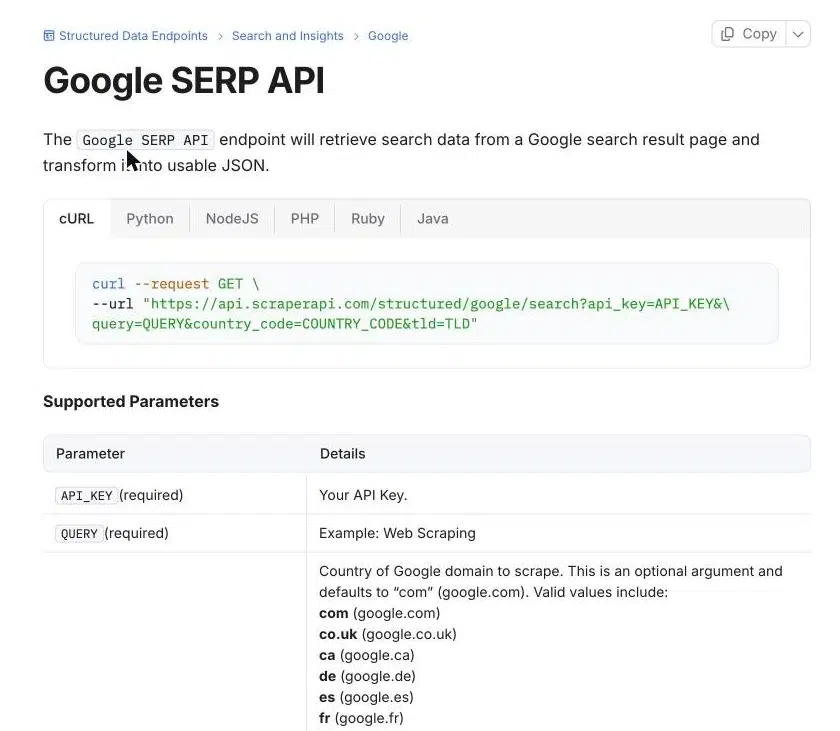
- ScraperAPI’s Google SERP API is one of ScraperAPI’s Structured Data Endpoints (SDEs), and it returns JSON or CSV from
/structured/google/search. - The Google SERP API takes
tld(21 Google domains),country_code,hl,gl,tbs,start, andoutput_formatparameters. - ScraperAPI charges only successful requests (200 and 404 responses).
- The Google SERP API targets a country, with no city-level targeting.
- ScraperAPI’s Async Scraper takes up to 50,000 URLs per batch, retries for up to 24 hours, and calls a webhook when results are ready.
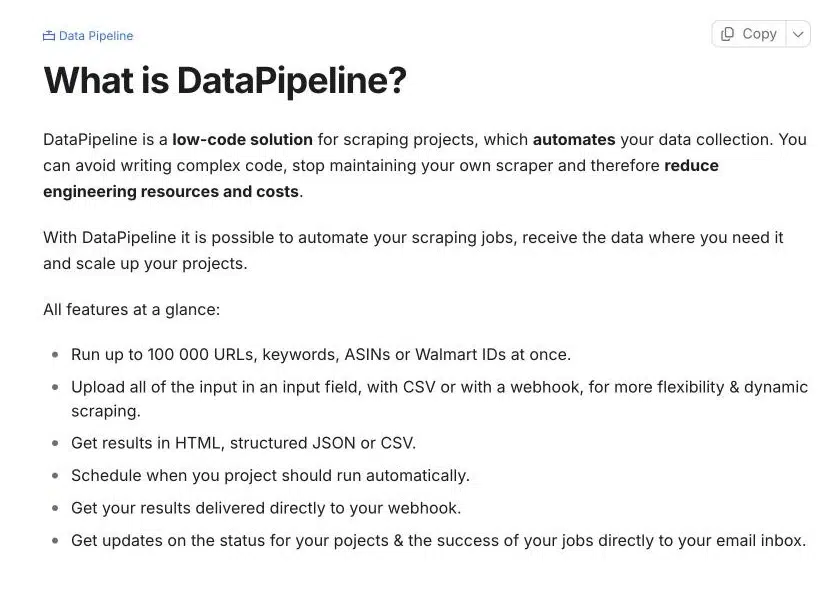
- ScraperAPI’s DataPipeline runs up to 100,000 URLs or keywords per project on an hourly, daily, weekly, or monthly schedule (or a cron expression), accepts input from a field, a CSV, or a webhook, and returns HTML, JSON, or CSV to a webhook.
- ScraperAPI’s AI Results endpoints return answers from ChatGPT, Perplexity, Gemini, and Google AI Mode, and ScraperAPI includes an MCP server, a CLI, a Claude plugin, and n8n, Zapier, LangChain, and LlamaIndex integrations.
ScraperAPI pros and cons:
| Pros | Cons |
|---|---|
| One vendor covers the SERP, retries, scheduling, and delivery, and ScraperAPI includes an MCP server, a CLI, and n8n, Zapier, LangChain, and LlamaIndex integrations. | A Google search costs 25 ScraperAPI credits, so entry plans cost more per 1,000 searches than per-request SERP APIs. |
| ScraperAPI’s AI Results endpoints return answers from ChatGPT, Perplexity, Gemini, and Google AI Mode. | ScraperAPI returns the data and does not store rank history or provide a dashboard. |
| ScraperAPI charges only successful requests. | ScraperAPI’s Google SERP API targets countries only, with no city-level targeting. |
What customers think about ScraperAPI
ScraperAPI holds a 4.3 out of 5 rating on G2 from 15 reviews. Reviewers like the fast, efficient scraping, the easy and reliable API, and the automated proxy handling.
However, they dislike costs that add up at higher usage, rate-limit frustration, and setup that can be complex on some sites. Read the reviews on G2.
ScraperAPI pricing
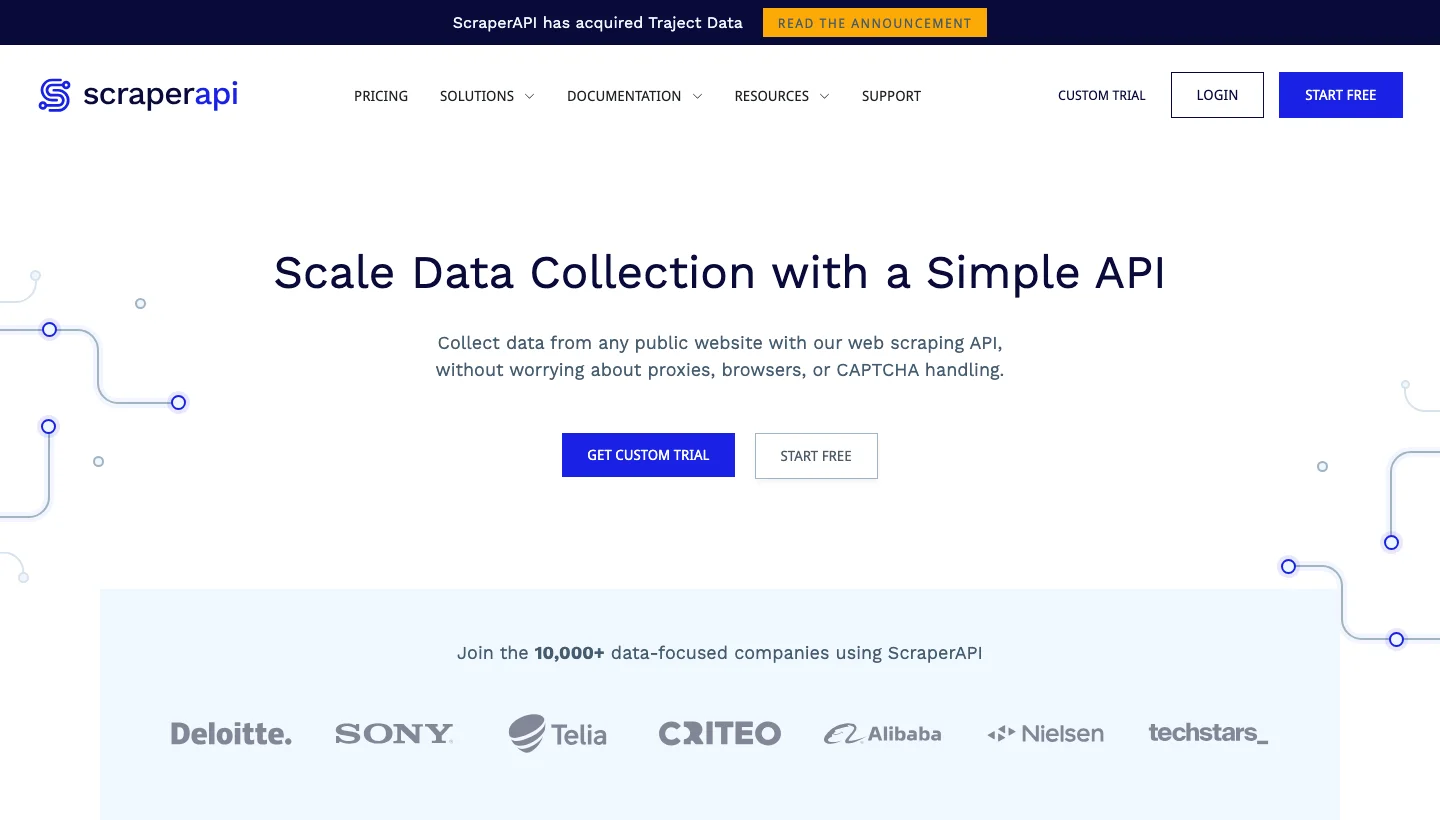
ScraperAPI bills a monthly credit pool, and a Google search costs 25 ScraperAPI credits. At that rate, 1,000 Google searches cost $11.03 on Hobby, $3.35 on Startup, $2.24 on Business, and $2.14 on Scaling when billed annually.
ScraperAPI’s plans are:
- Hobby: $49 a month ($44.10 billed annually, 10% off) for 100,000 credits.
- Startup: $149 ($134.10) for 1,000,000 credits.
- Business: $299 ($269.10) for 3,000,000 credits.
- Scaling: $475 ($427.50) for 5,000,000 credits.
- Professional: $975 ($877.50) for 10,500,000 credits.
- Advanced: $1,975 ($1,777.50) for 21,500,000 credits.
- Enterprise: custom.
Pay-as-you-go starts on Scaling, and ScraperAPI’s 7-day trial includes 5,000 credits with no card.
See ScraperAPI pricing.
2. SerpWow by ScraperAPI: Best for teams that need multi-engine SERP data with city and ZIP targeting
SerpWow by ScraperAPI is a SERP API from Traject Data, which ScraperAPI acquired in 2025. It is a separate product from ScraperAPI’s Google SERP API, with its own plans and its own billing, so ScraperAPI credits do not pay for SerpWow by ScraperAPI searches, and SerpWow by ScraperAPI credits do not pay for ScraperAPI requests.
SerpWow by ScraperAPI returns search results from Google, Bing, Yahoo, Baidu, Yandex, Naver, Amazon, and eBay, and it localizes searches down to ZIP and postal codes. It fits developers and data teams that build their own tracker and need more than country-level targeting or more than one engine.
It is not built for teams that want a finished dashboard with stored history.
SerpWow by ScraperAPI top features:
- The
engineparameter selects Google, Bing, Yahoo, Baidu, Yandex, Naver, Amazon, or eBay. - The
locationparameter takes free text or a location from the Locations API, which also setsgoogle_domain,gl, andhl, and SerpWow by ScraperAPI lists targeting down to ZIP and postal codes. - The
deviceparameter takes desktop, tablet, or mobile. include_ai_overviewadds Google AI Overview content to a result, and it costs one additional credit when an overview is returned.pageandmax_pagepaginate results at one credit per page returned.- Output is JSON, CSV, or HTML.
- SerpWow by ScraperAPI also covers Google News, Trends, Images, Videos, Reverse Image, Maps, and Shopping results.
- Batches run up to 10,000 searches at once and deliver by API pull, webhook, or S3, GCS, and Azure storage.
SerpWow by ScraperAPI pros and cons:
| Pros | Cons |
|---|---|
| One API returns Google, Bing, Yahoo, Baidu, Yandex, Naver, Amazon, and eBay results. | SerpWow by ScraperAPI stores no rank history and has no dashboard, so you build the tracker. |
ZIP and postal-code targeting through the location parameter. | Billing is credit-based, and an AI Overview adds a credit when one is returned. |
| Batches deliver up to 10,000 searches to a webhook or to S3, GCS, or Azure storage. | SerpWow by ScraperAPI is billed separately from ScraperAPI, so it needs its own plan. |
What customers think about SerpWow by ScraperAPI
SerpWow by ScraperAPI has a G2 listing, published by Traject Data, with no reviews yet. See the G2 page.
Teams that track rankings through Traject Data’s SERP APIs say they work at scale. Andrew Shotland, Chief Executive Officer of LSG SEO, uses SerpWow by ScraperAPI for share-of-voice projects:
“Traject Data (now acquired by ScraperAPI) allows us to look at the SERPs at scale. So now whenever we start with a new client, we do this project around Share of the Voice as part of our strategy.”
-Andrew Shotland, Chief Executive Officer, LSG SEO
Semify, a white-label SEO agency, uses Value SERP, another SERP API from Traject Data (which ScraperAPI acquired), and describes batching this way:
“We used to send tens of thousands of API calls a day individually. Now we can pass in a batch and get back keywords in a more structured, efficient way.”
-Brendan Ganning, Vice President of Engineering, Semify
SerpWow by ScraperAPI pricing
SerpWow by ScraperAPI bills a monthly search allowance, with one credit per Google results page, and it is billed separately from ScraperAPI. Billing annually saves 20%. SerpWow by ScraperAPI’s plans are:
- Hobbyist: $38 a month for 1,000 searches, then $0.076 per extra search.
- BigData: $499 ($399 billed annually) for 50,000 searches, then $0.01996 per extra search.
- Volume: $1,200 ($960) for 250,000 searches, then $0.0096 per extra search.
- Infrastructure: $2,999 ($2,399) for 1,000,000 searches, then $0.005998 per extra search.
- Infrastructure XL: $9,000 ($7,200) for 5,000,000 searches, then $0.0036 per extra search.
A free trial is available. At one credit per Google search, 1,000 searches cost $7.98 on BigData, $3.84 on Volume, $2.40 on Infrastructure, and $1.44 on Infrastructure XL when billed annually. See SerpWow by ScraperAPI plans.
3. SE Ranking: Best for agencies that want a rank tracker API inside a full SEO platform
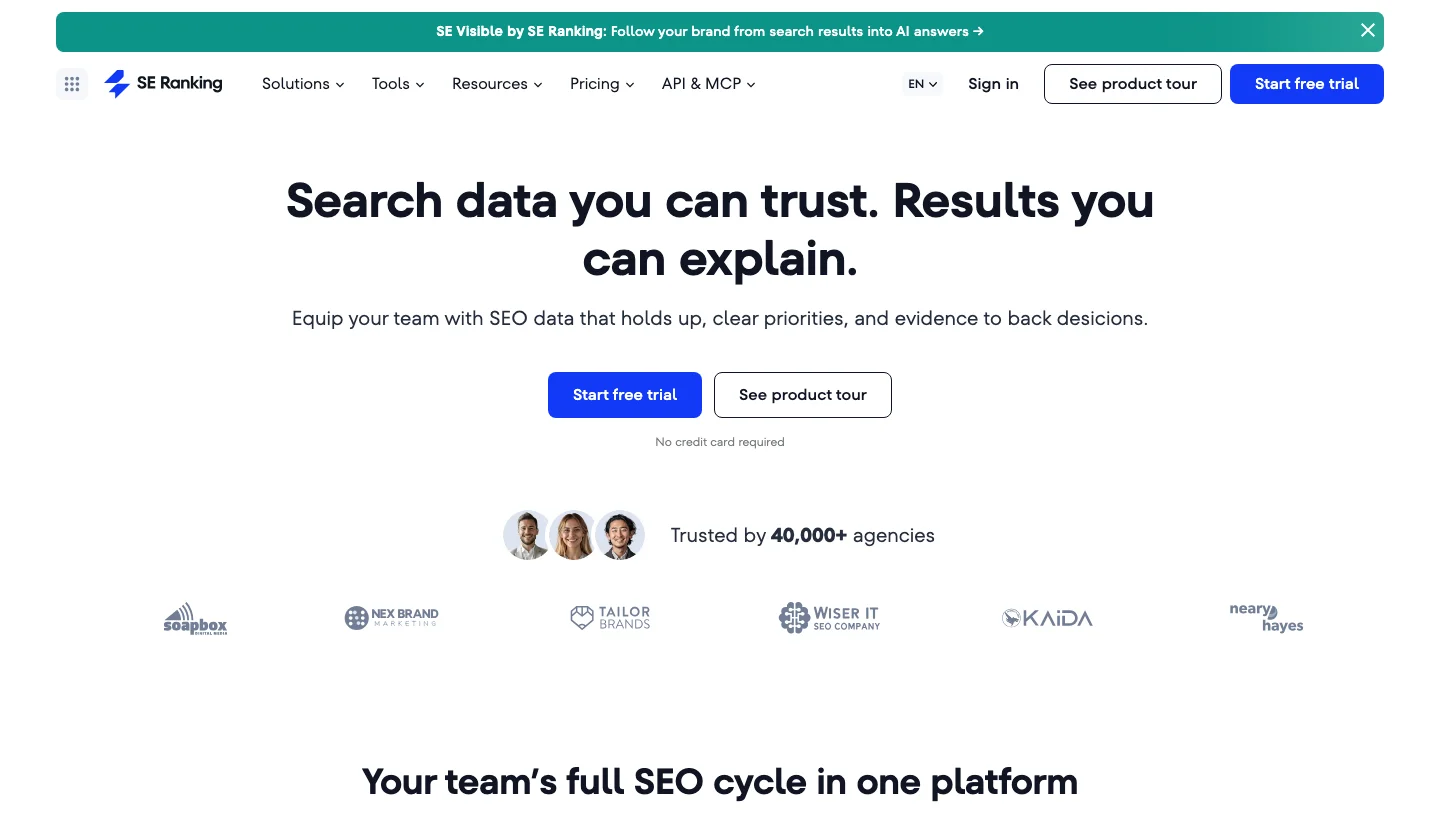
SE Ranking is a full SEO platform whose rank tracker is exposed through a REST Project API. Agencies use it to push projects, keywords, positions, and history into their own dashboards.
However, it is not built for buying rank tracking by API alone: the standalone API plan covers its Data API only, and rank tracking calls run on a platform plan and its keyword limits.
SE Ranking top features:
- Project API endpoints create, edit, and delete projects and keywords.
- Endpoints return positions, position history, and check dates, and they trigger on-demand rechecks.
- Check schedules run daily, every third day, weekly, monthly, or manually.
- Google, Bing, Yahoo, and YouTube are tracked on desktop and mobile.
- Competitor positions and 35+ SERP features per keyword, including AI Overviews, come back through the API.
- An AI Results Tracker covers ChatGPT, AI Overviews, AI Mode, and Gemini.
- The Project API allows 5 requests per second per key.
- An MCP server and Make, n8n, and Zapier connections are available.
SE Ranking pros and cons:
| Pros | Cons |
|---|---|
| Rank tracking, audits, backlinks, and reporting sit in one subscription, and the Project API reads and writes. | G2 reviewers report usage limits that bite on several large or local projects. |
| Bing and Yahoo are tracked next to Google. | Newer features, such as the API add-on, are paid on top of the monthly plan, according to G2 reviewers. |
| On-demand rechecks and a schedule per project. | One Reddit commenter reported erratic position numbers from mid-September 2026 (r/SEO). |
What customers think about SE Ranking
SE Ranking holds a 4.7 out of 5 rating on G2 from 1,619 reviews. Reviewers like the friendly interface, the all-in-one reporting suite that agencies find good value, the keyword research, the AI result tracking, and the clear dashboards.
On the other hand, they dislike some limited features, a price that feels high because of exchange rates and plan limits, a learning curve, and many paid add-ons. Read the reviews on G2.
SE Ranking pricing
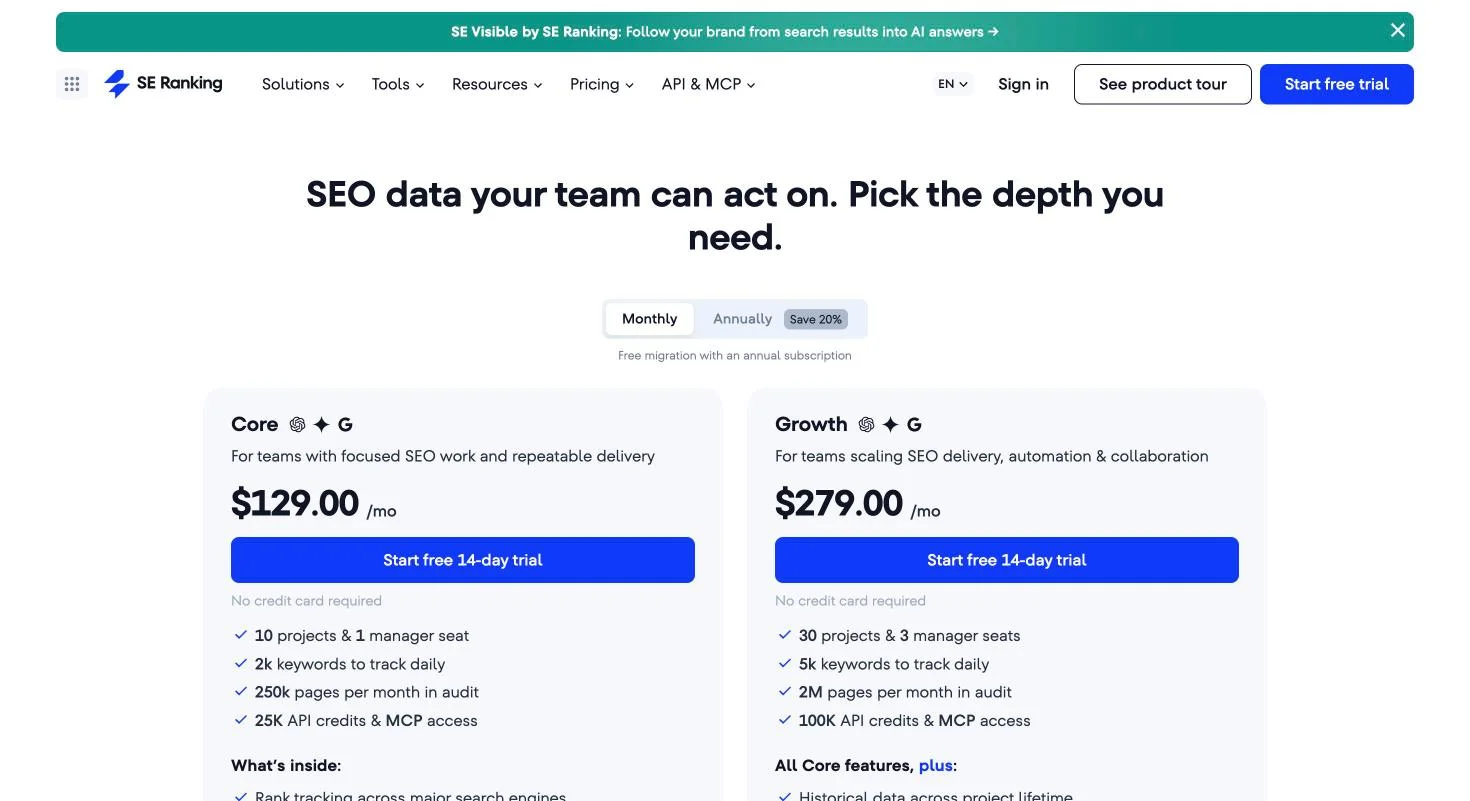
SE Ranking bills a monthly plan with a daily keyword allowance, and the Project API draws on plan limits, not credits. Its plans and add-ons are:
- Core: $129 a month for 2,000 keywords tracked daily, 10 projects, and 25,000 API credits.
- Growth: $279 a month for 5,000 keywords tracked daily.
- Enterprise: custom.
- API add-on: from $29 a month on monthly billing.
- Standalone Data API: $179 a month billed annually.
A 14-day trial needs no card. See SE Ranking pricing.
4. AccuRanker: Best for agencies and enterprises that want a read and write rank tracking API
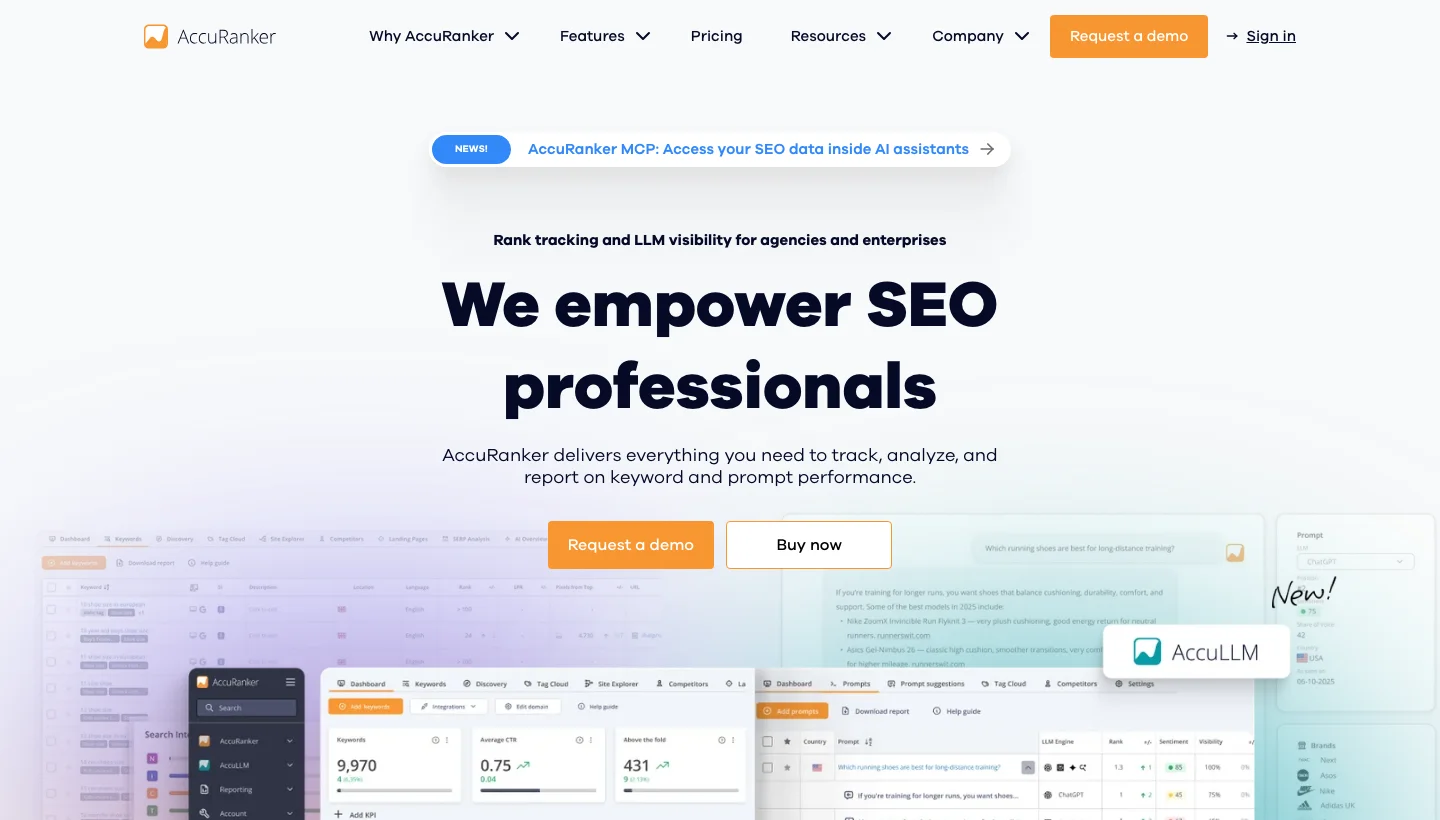
AccuRanker describes itself as rank tracking and LLM visibility for agencies and enterprises. Its Read API v4 pulls ranks, competitor ranks, and share-of-voice history, while its Write API v4 creates keywords and domains.
It is not built for low volumes, since the entry plan is 2,000 keywords, and the Professional plan lists neither API.
AccuRanker top features:
- Read API v4 returns domains, keywords, landing pages, tags, ranks, competitor ranks, and share-of-voice history.
- Write API v4 creates and updates groups, domains, and keywords, and it returns a job ID for each batch.
- Search volume history goes back up to four years.
- Google is tracked by country and location on desktop and mobile, with on-demand refresh of a keyword or a whole domain in the app.
- 45+ SERP features are tracked, including how many keywords trigger an AI Overview.
- AccuLLM tracks ChatGPT, Perplexity, AI Overviews, and AI Mode.
- AccuSERP is a separate SERP API with parsed JSON or raw HTML at 10 credits per base request.
- Search Console, Analytics, Data Studio, BigQuery, Swydo, a CSV import, and an MCP server connect it to reporting.
AccuRanker pros and cons:
| Pros | Cons |
|---|---|
| Daily updates, share of voice, and four years of search volume history over the API. | G2 reviewers find the price heavy for freelancers and small teams. |
| Read and write APIs, plus a separate SERP API (AccuSERP) for raw results. | G2 reviewers miss backlink analysis and deeper keyword research, since it tracks ranks only. |
| 45+ SERP features and AI Overview triggers tracked. | G2 reviewers report that mobile and each Google country count as separate keywords, and one reports false competitor-link alerts. |
What customers think about AccuRanker
AccuRanker holds a 4.8 out of 5 rating on G2 from 233 reviews. Reviewers like the accurate rankings with daily updates, the data they trust, the competitor analysis, and the Search Console and Analytics integrations.
In contrast, they dislike limits on keyword management, limited keyword search options, a price that feels heavy for freelancers, and false competitor-related alerts. Read the reviews on G2.
AccuRanker pricing
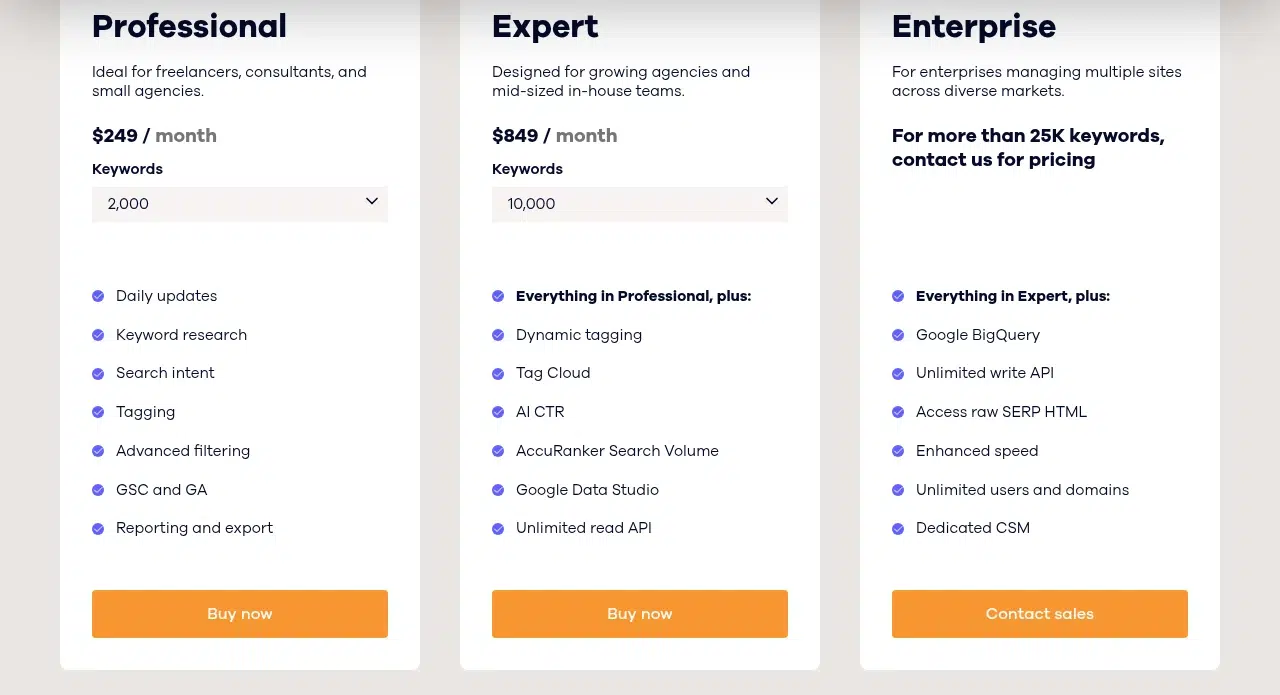
AccuRanker bills a monthly plan sized by tracked keywords, and it charges in US dollars outside Europe. Its plans are:
- Professional: from $249 a month for 2,000 keywords, with tiers up to 5,000 keywords.
- Expert: from $849 a month for 10,000 keywords, with tiers up to 25,000 keywords.
- Enterprise: by quote above 25,000 keywords.
The pricing page lists an unlimited Read API from Expert and an unlimited Write API on Enterprise, and it offers a demo in place of a trial. Its refund page returns the full price within the first 14 days of a first purchase, and its terms treat prepaid fees as non-refundable after that.
See AccuRanker pricing.
5. Keyword.com: Best for agencies that want API access on every plan and city or ZIP targeting
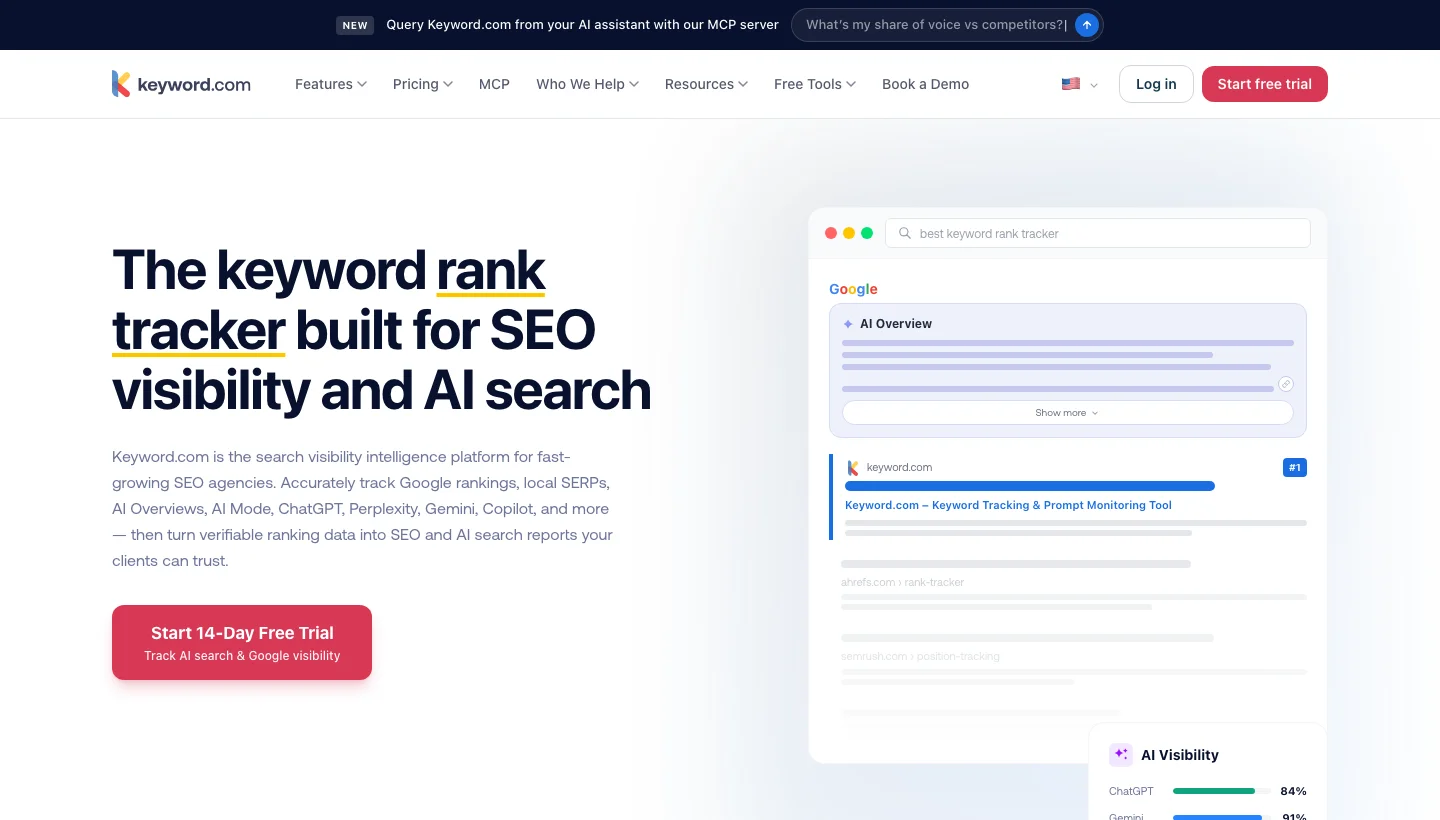
Keyword.com sells a keyword rank tracker for SEO visibility and AI search, with a REST API on every plan. Agencies and in-house teams use it to add keywords, refresh on demand, and pull rank history, competitors, and share of voice.
It is not built for engines beyond Google in classic SERP tracking, or for pay-per-request billing.
Keyword.com top features:
- REST API v2 covers projects, keywords, on-demand refresh, ranking metrics, competitors, regions, and top pages.
- Rank history returns up to 180 days per call, with share-of-voice and alert endpoints.
- Google tracking supports country, language, city, and ZIP targeting.
- Updates run daily at 00:00 UTC or weekly on Mondays.
- AI Overview detection is included on every API plan.
- AI visibility tracking covers Google AI Overview, AI Mode, ChatGPT, Gemini, and Copilot, plus Claude, OpenAI Search, Perplexity Sonar, Mistral, DeepSeek, and Grok, on credits.
- Keyword endpoints allow 60 requests per minute, and SERP history storage is unlimited.
- A 56-tool MCP server is available.
Keyword.com pros and cons:
| Pros | Cons |
|---|---|
| API access is included in every plan, with unlimited SERP history storage. | G2 reviewers say daily updates and AI visibility cost noticeably more than the weekly entry price. |
| City and ZIP targeting on Google. | G2 reviewers cannot compare competitors on one keyword in one view and miss a local grid. |
| AI Overview detection on every API plan. | One G2 reviewer says AI visibility data is not shown in the free trial. |
What customers think about Keyword.com
Keyword.com holds a 4.7 out of 5 rating on G2 from 111 reviews. Reviewers like the ease of use, the flexible and thorough rank tracking, the accurate rankings, and the value for money.
However, they dislike a price that is high for freelancers and small businesses, weak competitor analysis, a limited data set, and limited features overall. Read the reviews on G2.
Keyword.com pricing
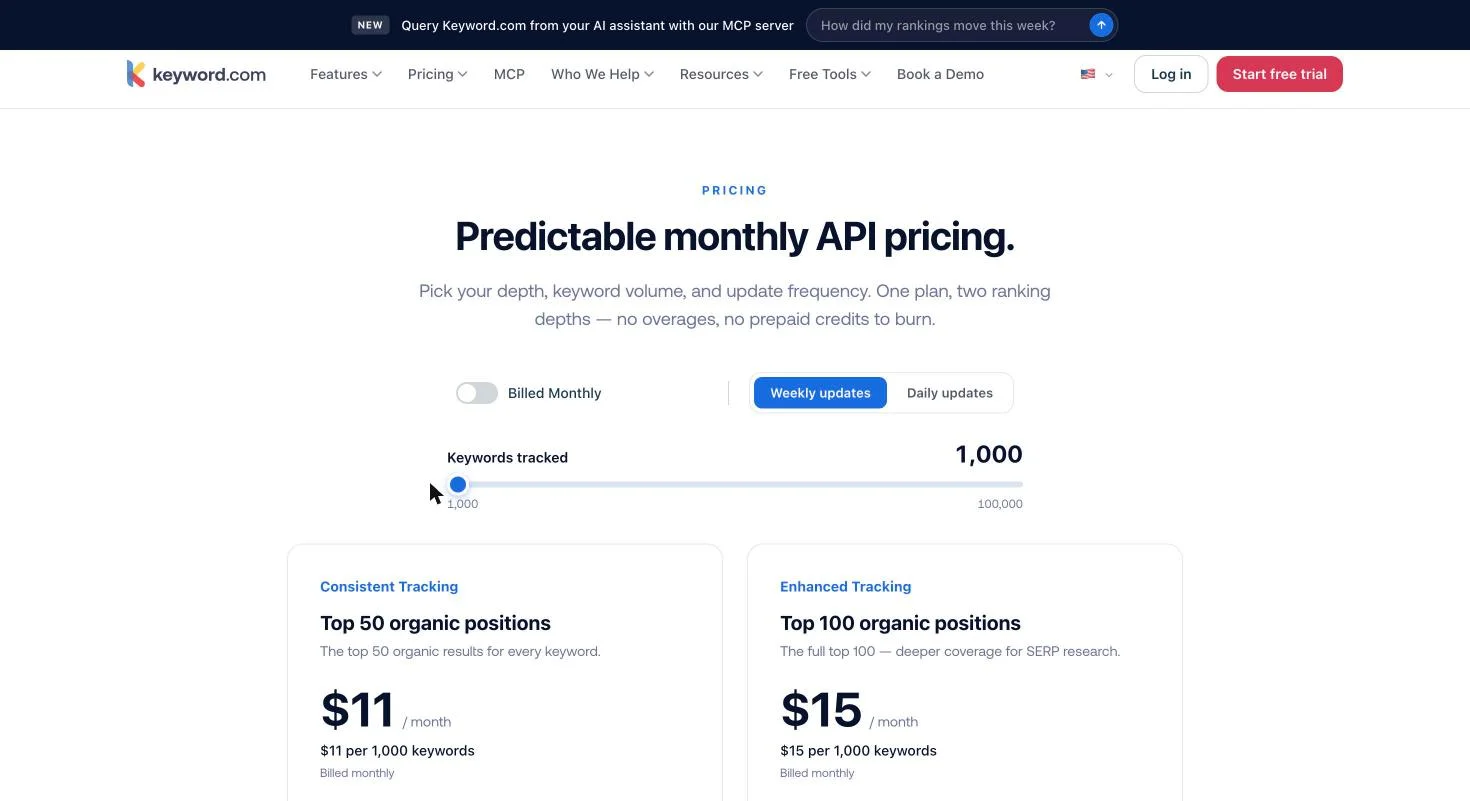
Keyword.com bills one keyword credit per phrase, and desktop plus mobile counts as two. API-only plans at 1,000 keywords billed monthly are:
- Weekly updates, Top 50: $11 a month.
- Weekly updates, Top 100: $15 a month.
- Daily updates, Top 50: $37 a month.
- Daily updates, Top 100: $60 a month.
The price scales with keyword count up to 100,000. At 5,000 keywords billed monthly, weekly updates cost $48 for Top 50 and $65 for Top 100. The platform’s Search Visibility plan starts at $4 a month for 50 keywords updated weekly, or $16 updated daily.
A 14-day trial includes 100 keywords with no card, and fees are non-refundable under its terms. See Keyword.com API pricing.
6. DataForSEO: Best for developers who build a tracker at the lowest price per SERP
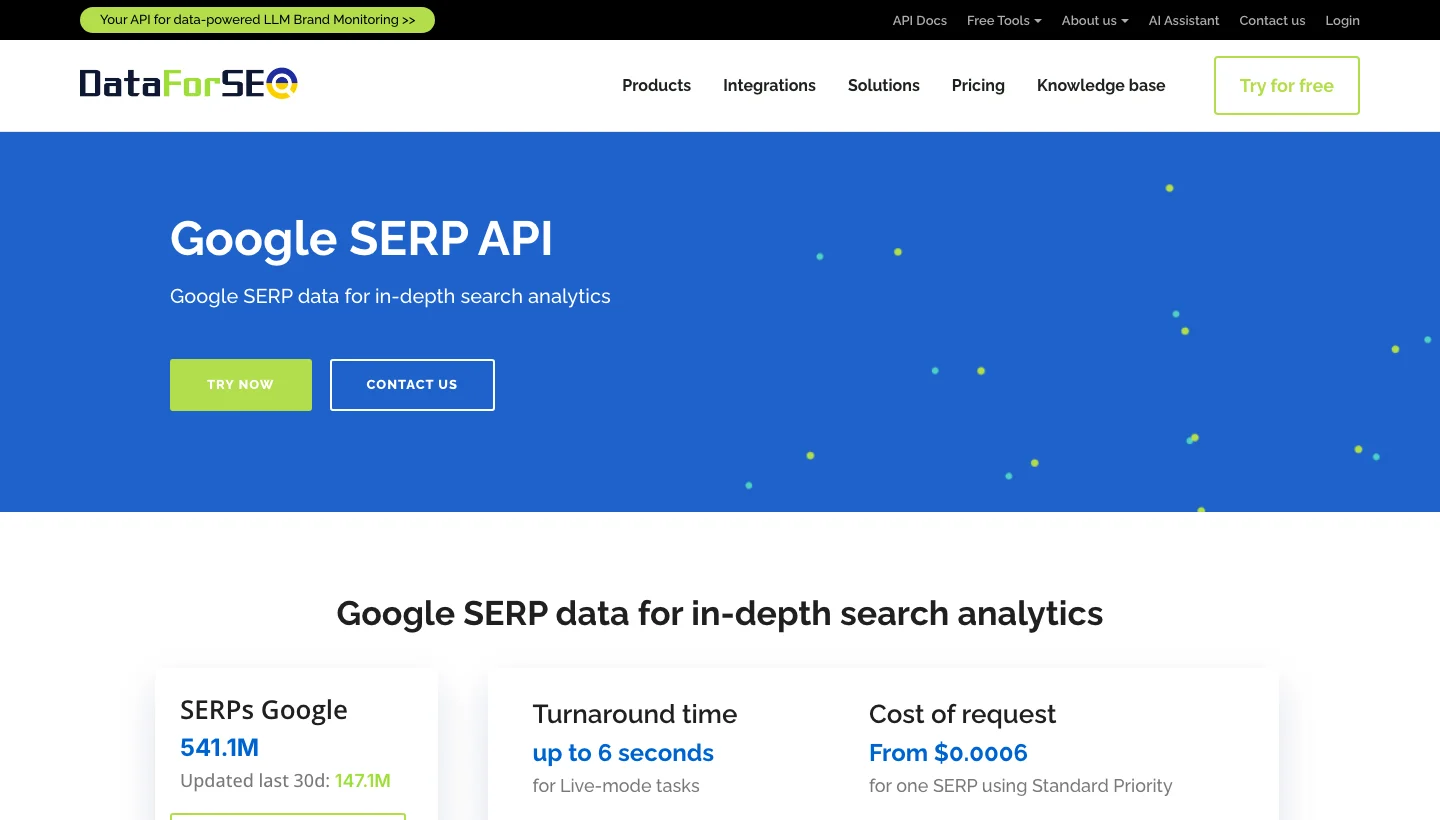
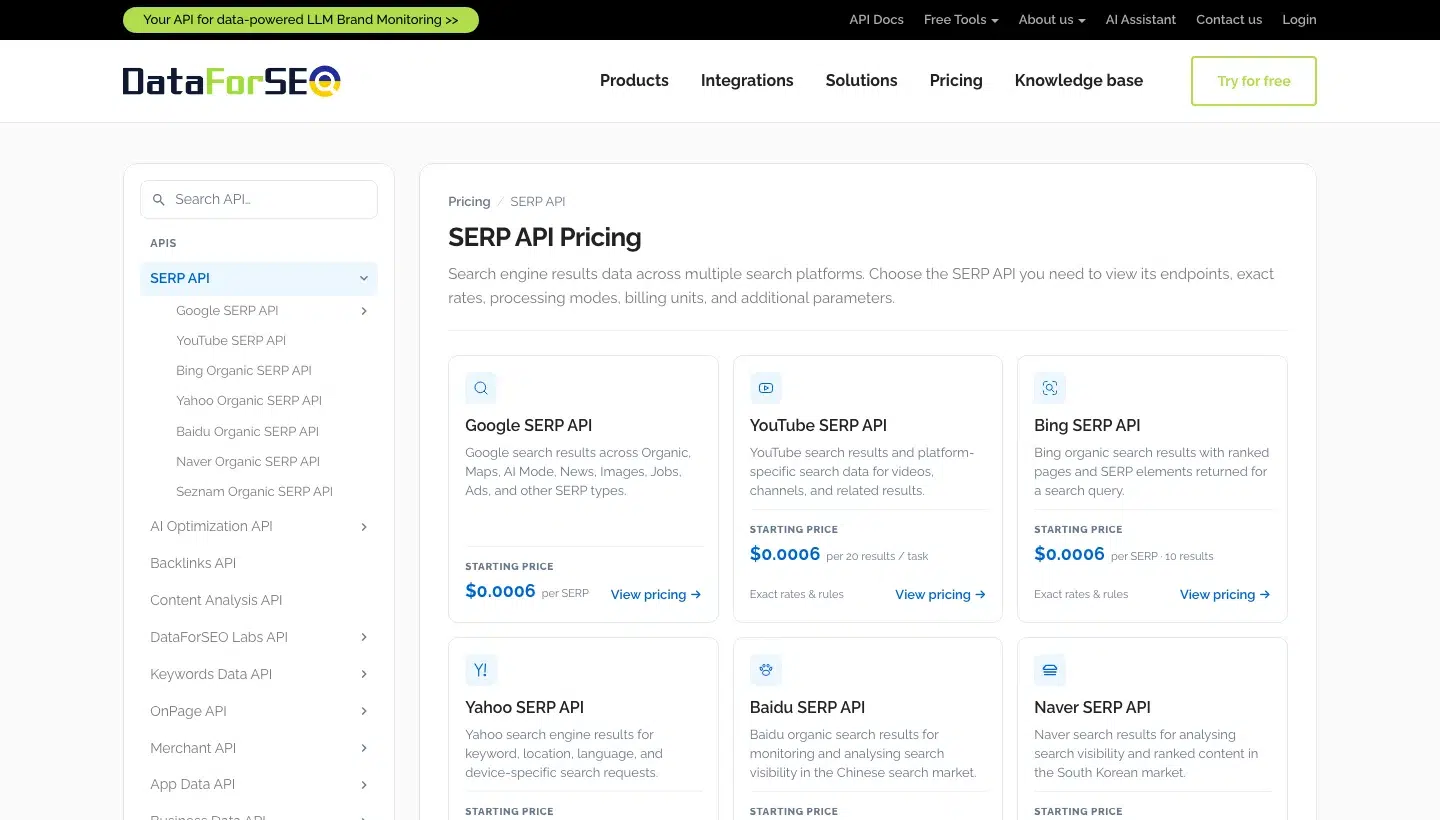
DataForSEO is a pay-as-you-go SERP API that returns Google results for any keyword, location, and language on desktop or mobile. Developers queue tasks in bulk, pick a speed by price, and add their own dashboard.
It is not built as a ready-made tracker with a history interface, and it asks for a $50 minimum top-up.
DataForSEO top features:
- Three speed modes: Standard queue (about 5 minutes on average), Priority (up to 1 minute), and Live (up to 6 seconds).
- Regular, Advanced, and HTML result functions, with Advanced returning every SERP element.
- Location by
location_code,location_name, or coordinates with a radius. - A
deviceparameter for desktop or mobile, withoschoices of Windows, macOS, Android, and iOS. - Up to 100 tasks per POST request and 10,000 calls a minute.
- Language by code or name.
- A Sandbox with sample responses and a $1 trial credit.
DataForSEO pros and cons:
| Pros | Cons |
|---|---|
| Lowest list price per SERP in this guide: $0.60 per 1,000 on the Standard queue. | A Reddit user received 17 or 18 results instead of 100 for several days, and results from another country on some days (r/localseo). |
| Speed is a price choice: Standard, Priority, or Live. | Reddit users reported broken localisation in October 2026 (r/SEO). |
| Sandbox and a $1 trial credit before any top-up. | One agency running Advanced Web Ranking next to DataForSEO saw the two tools contradict each other on about half its keywords (r/SEO). |
| It is a data API, so teams build or buy the dashboard (r/localseo). |
What customers think about DataForSEO
DataForSEO holds a 4.4 out of 5 rating on G2 from 17 reviews, and the listing covers the company, not the SERP API alone. Reviewers like the accurate, extensive data, the affordable pricing for the volume, and the customer service.
On the other hand, they dislike search volume data they judge less accurate than Semrush or Ahrefs. Read the reviews on G2.
DataForSEO pricing
DataForSEO bills per SERP of 10 results, and its rates are:
- Standard queue: $0.0006 per SERP ($0.60 per 1,000).
- Priority: $0.0012 per SERP ($1.20 per 1,000).
- Live: $0.002 per SERP ($2.00 per 1,000).
New accounts get a $1 trial credit, the top-up minimum is $50, and its terms give a 30-day refund on a first purchase of credits. See DataForSEO pricing.
7. SerpApi: Best for developers who want real-time Google JSON with city-level location on a fixed plan
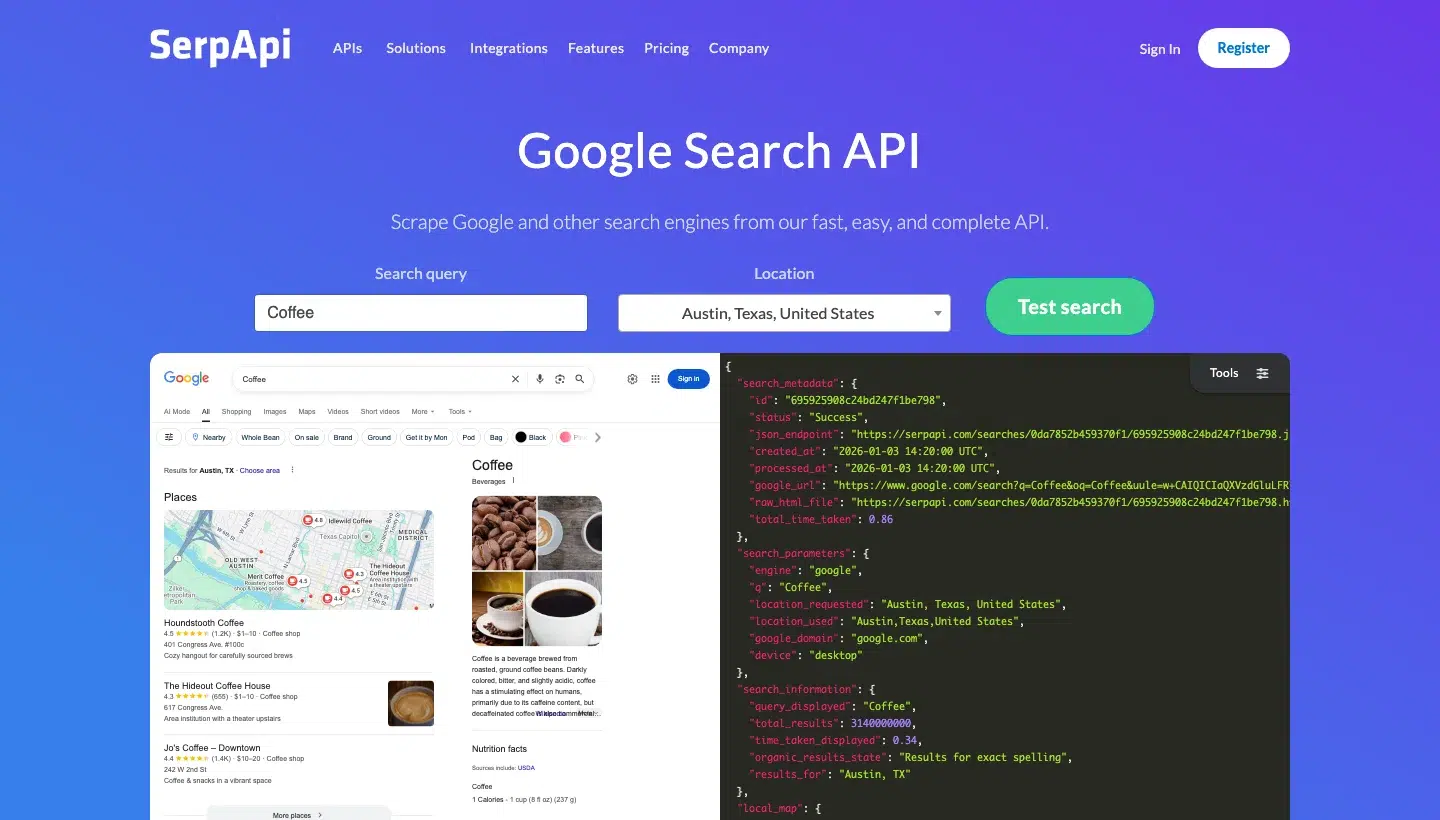
SerpApi describes itself as a real-time API to access Google search results, and it handles proxies, CAPTCHAs, and parsing. Developers pass a location, a device, and a start offset, and they get JSON, HTML, or Markdown back.
It is not built for pay-as-you-go use or for storing history, since it keeps search data for 31 days. For alternatives, see ScraperAPI’s SerpApi alternatives page.
SerpApi top features:
location,uule,lat,lon, andradiusparameters, alongsidegl,hl, andgoogle_domain.- A
deviceparameter for desktop, tablet, or mobile. - Pagination with
start, in steps of 10 results, and nonumparameter. - JSON, raw HTML, and Markdown output.
- A
json_restrictorparameter that trims the response to chosen fields. - A Locations API that lists supported locations.
- A separate Google AI Overview API.
- Ludicrous Speed, a faster tier at twice the price.
SerpApi pros and cons:
| Pros | Cons |
|---|---|
City-level location with device choice on every plan. | G2 reviewers find the price high for students, academics, and budget-conscious teams. |
| Only successful searches count, and the number of results returned does not change the credit use. | G2 reviewers want a base tier for sporadic use, a clearer credit explanation, and more advanced customisation. |
| Markdown output for LLM pipelines. | One Reddit developer found the target keyword in 2 of 10 identical requests with the location set (r/SEO). |
What customers think about SerpApi
SerpApi holds a 4.8 out of 5 rating on G2 from 30 reviews. Reviewers like how easy it is to use, the accurate and reliable data, the easy integration, and the affordable pricing for startups.
In contrast, they dislike the cost for budget-conscious teams, limited customisation, subscription inflexibility, and an unclear credit system. Read the reviews on G2.
SerpApi pricing
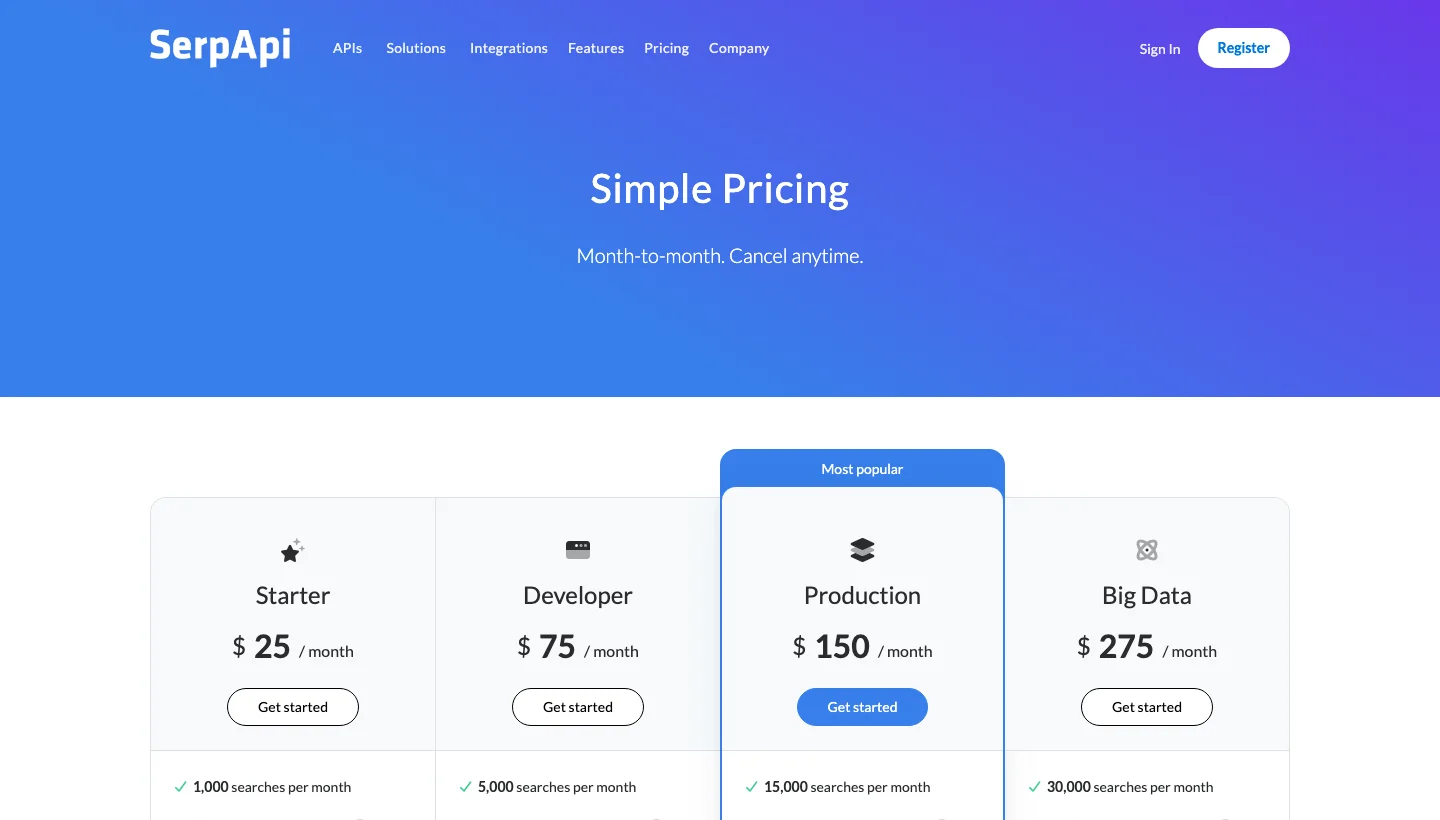
SerpApi bills searches per month, and only successful searches are counted. Its plans are:
- Free: 250 searches a month (50 an hour).
- Starter: $25 for 1,000 searches ($25.00 per 1,000).
- Developer: $75 for 5,000 searches ($15.00 per 1,000).
- Production: $150 for 15,000 searches ($10.00 per 1,000).
- Big Data: $275 for 30,000 searches ($9.17 per 1,000).
- Searcher: $725 for 100,000 searches ($7.25 per 1,000).
Refunds are available within 7 days unless more than 20 percent of the searches are used. See SerpApi pricing.
8. Bright Data SERP API: Best for high-volume, multi-engine collection with pay-per-success billing
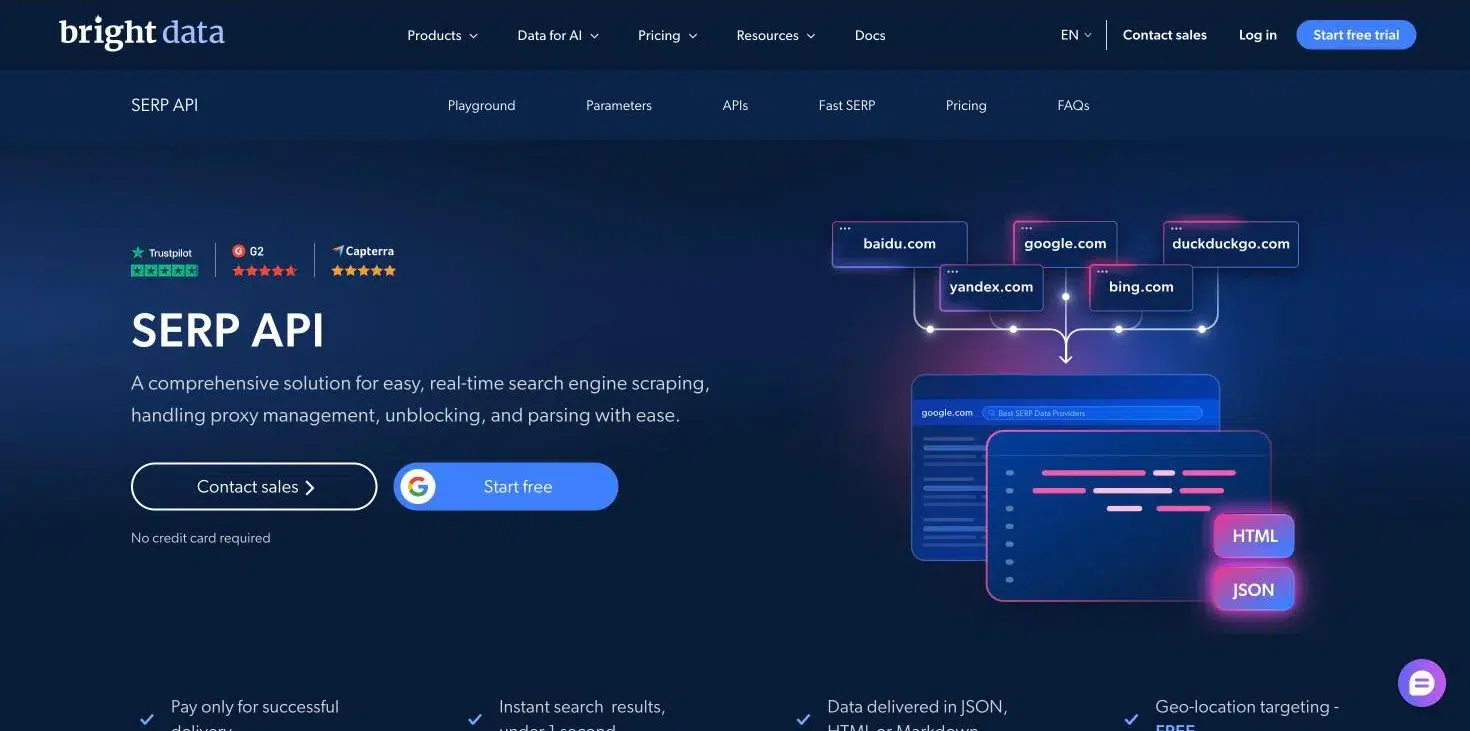
Bright Data’s SERP API collects structured search results from Google, Bing, and other engines, and it bills only successful requests. Teams collecting at volume send keyword requests with a location and device, then take the results by API or webhook.
It is not built for a quick start on a flat plan or for a dashboard.
Bright Data SERP API top features:
- Google, Bing, Yandex, and DuckDuckGo are supported.
- 195 countries with city-level targeting, and
uulefor Google locations. - A
brd_mobileparameter selects desktop, mobile, iOS, iPad, Android, or Android tablet. - Concurrency is unlimited.
- JSON (full or light), HTML, Markdown, and screenshot output.
- Asynchronous mode bills only the send request.
- Results are delivered by API response or webhook.
Bright Data SERP API pros and cons:
| Pros | Cons |
|---|---|
| Pay-per-success billing at $1.50 per 1,000 requests and no concurrency limit. | G2 reviewers find it costly for small teams and pricing hard to read. |
| Four engines and city-level targeting. | G2 reviewers describe a steep learning curve and thin documentation. |
| Asynchronous mode bills only the send request. | G2 reviewers note a limited dataset and tool range, so custom work is needed. |
What customers think about Bright Data
Bright Data holds a 4.7 out of 5 rating on G2 from 349 reviews, and the listing covers the whole company (proxies, scrapers, and datasets), not the SERP API alone. Reviewers like the fast customer support, the ease of use for scraping, and the reliable data collection.
However, they dislike a limited dataset and tool range, high cost for smaller teams, unclear pricing, and thin documentation. Read the reviews on G2.
Bright Data SERP API pricing
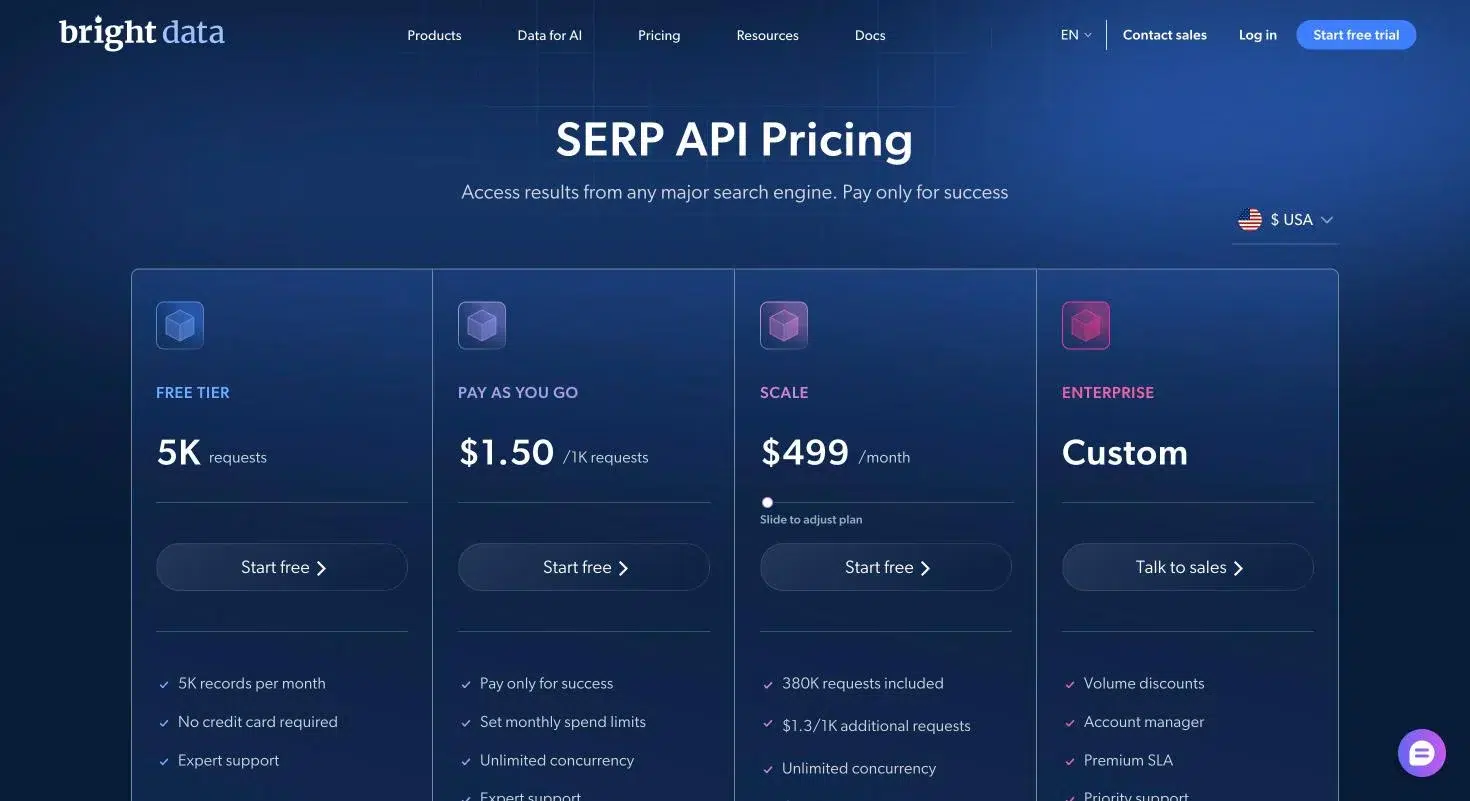
Bright Data bills per 1,000 successful requests, and failed requests are free unless custom headers or cookies are set. Its plans are:
- Free tier: 5,000 requests a month, one pool shared across Bright Data’s APIs, with no card needed on the pricing page.
- Pay-as-you-go: $1.50 per 1,000 requests.
- Scale: $499 a month with 380,000 requests included and $1.30 per 1,000 additional requests.
- Enterprise: custom.
Subscription fees are non-refundable under its licence agreement. See Bright Data SERP API pricing.
9. Scrapingdog: Best for developers who want a general scraping API with a low-priced Google SERP endpoint
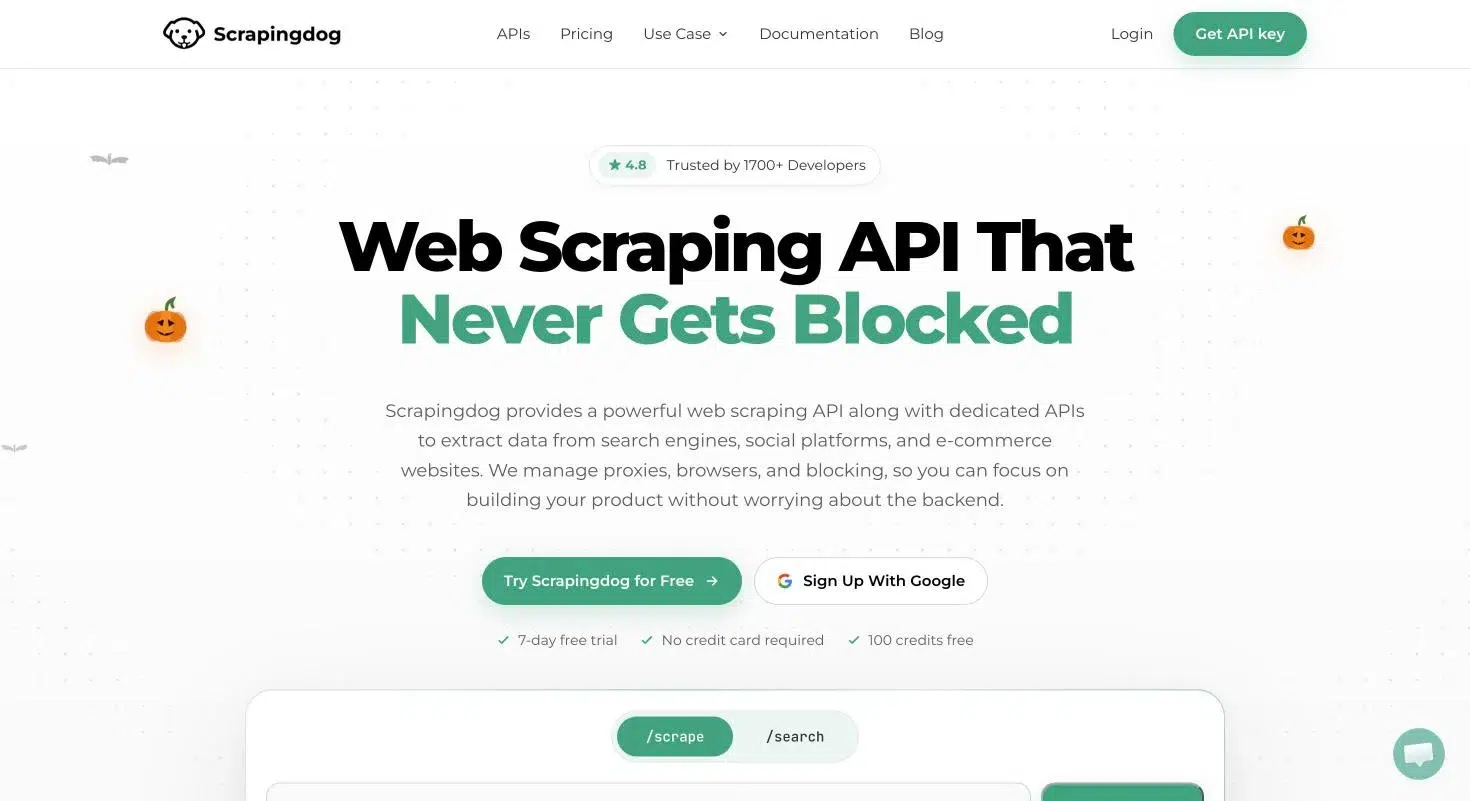
Scrapingdog provides a web scraping API with a dedicated Google SERP API, billed in credits. Developers send a query with country, domain, language, or location and read the rank from organic_results. It is not a hosted rank tracker with stored history.
Scrapingdog top features:
- A dedicated Google SERP API returns organic results, ads, featured snippets, and People Also Ask as JSON.
country,domain,language,location, anduuleparameters set the market, withlocationrecommended at city level.mob_search=truereturns mobile results at 10 credits.advance_search=truereturns advanced results at 10 credits.html=truereturns the raw page.- AI Overview comes back inline or through a fallback second call at 5 credits, and a separate AI Mode API costs 10 credits.
- Official Node.js and Python SDKs and an MCP server are available under the MIT licence.
- Failed, blocked, and timed-out requests are credited back.
Scrapingdog pros and cons:
| Pros | Cons |
|---|---|
| A standard Google search costs 5 credits, which is $1.00 per 1,000 searches on Lite. | An agency running its rank tracker on Scrapingdog called it unreliable, with no communication about downtime (r/SEO). |
| SDKs for Node.js and Python and an MCP server. | G2 reviewers report API failures and slow or unanswered support. |
| Mobile and AI Overview options on the same endpoint. | Older G2 reviews call the paid tiers costly and the docs unclear for non-developers. |
What customers think about Scrapingdog
Scrapingdog holds a 3 out of 5 rating on G2 from 5 reviews, a small sample. The positive review praises reliable, efficient scraping that is easy to integrate.
Meanwhile, the negative reviews cite API failures, thin reports, and slow or unanswered technical support. Read the reviews on G2.
Scrapingdog pricing
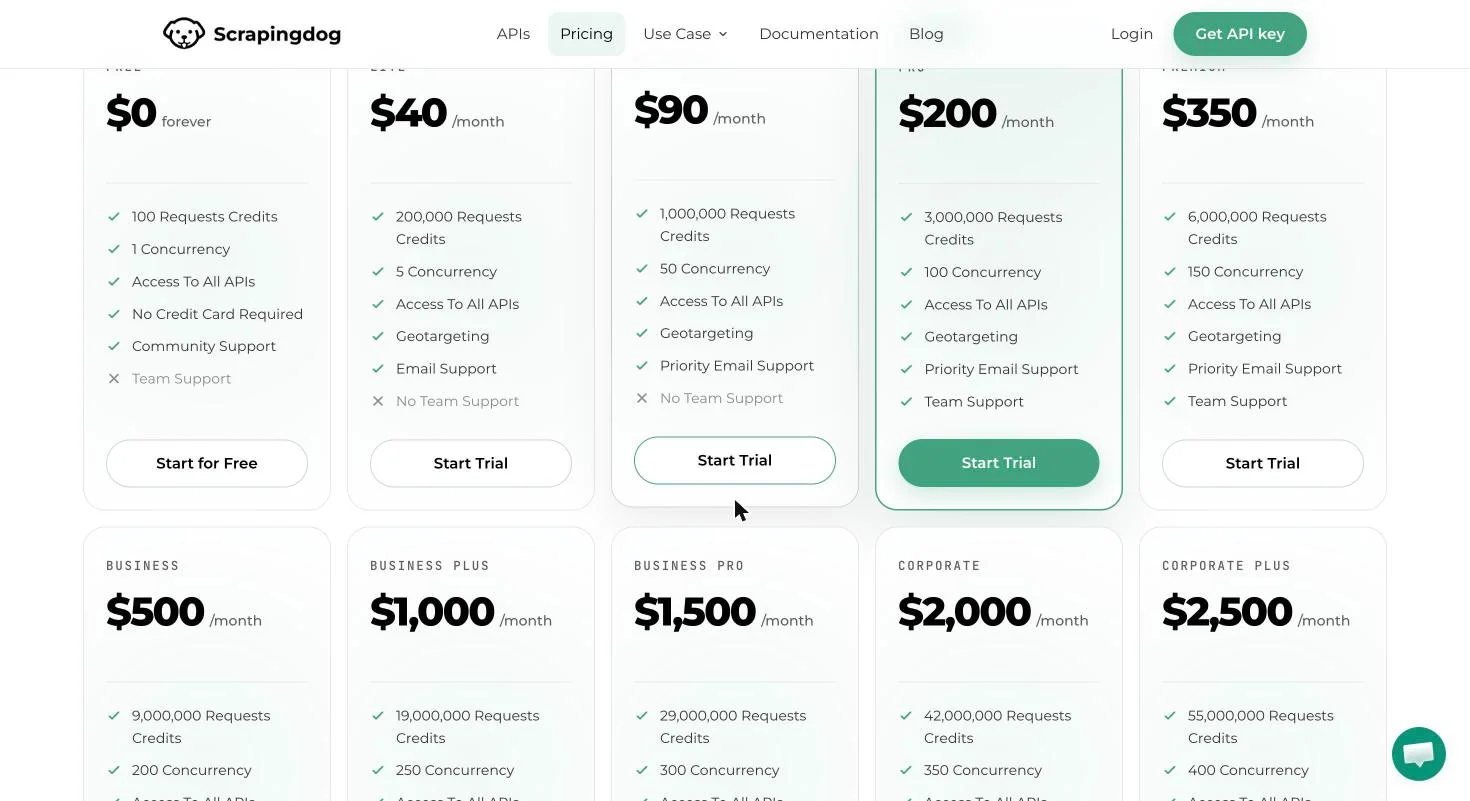
Scrapingdog bills credits per successful request, and a standard Google search costs 5 credits. Its plans are:
- Free: $0 for 100 credits, with no card.
- Lite: $40 a month for 200,000 credits ($1.00 per 1,000 searches).
- Standard: $90 for 1,000,000 credits ($0.45 per 1,000 searches).
- Pro: $200 for 3,000,000 credits.
- Premium: $350 for 6,000,000 credits.
- Larger plans: from Business at $500 for 9,000,000 credits up to Nova Pro at $30,000 for 1.1 billion credits.
Its terms give no refunds once services are rendered. See Scrapingdog pricing.
10. Zenserp: Best for teams that want a monthly-priced Google SERP API with AI Overview and batch endpoints
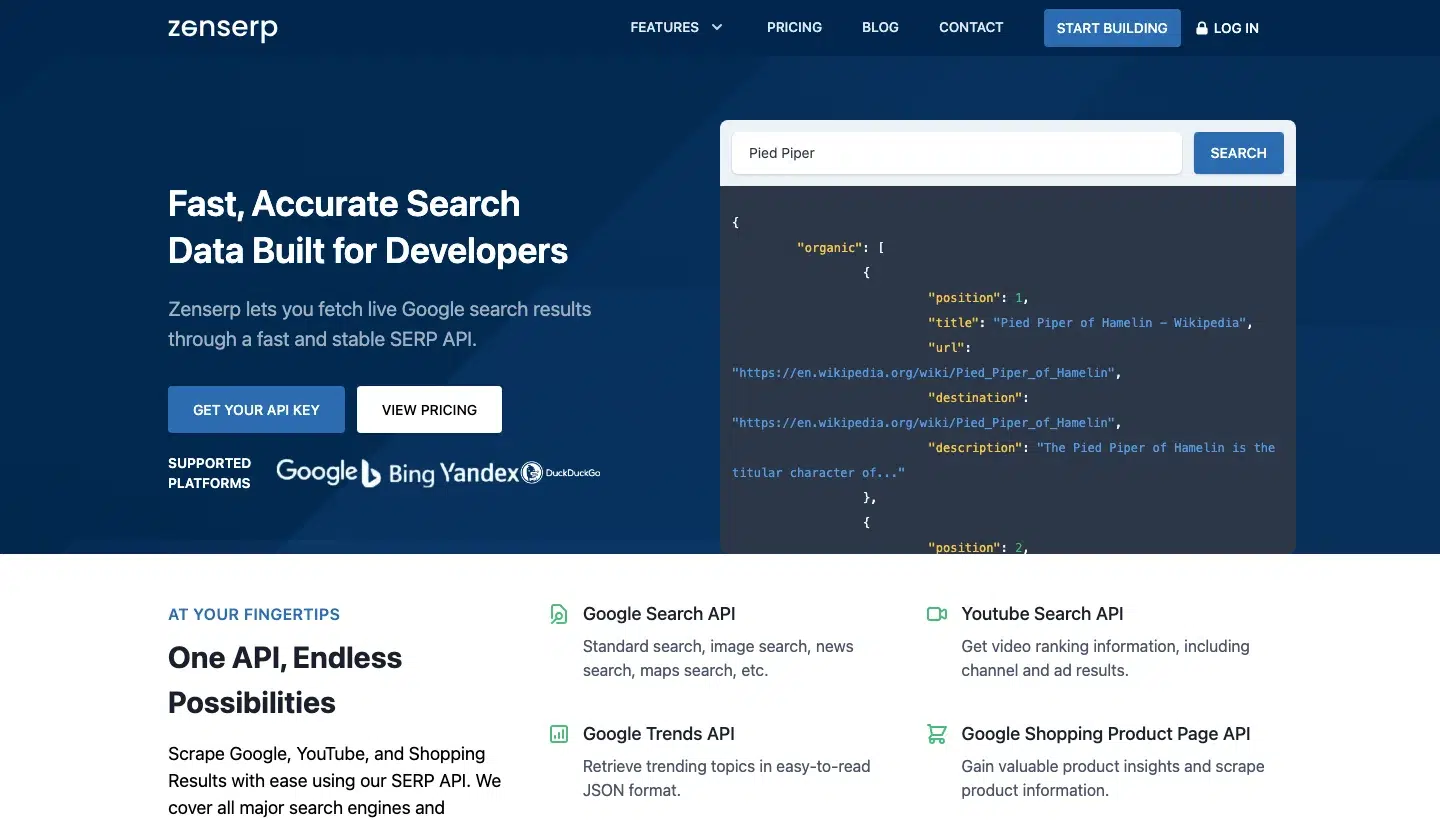
Zenserp, an APILayer product, lets teams fetch live Google results through a SERP API with location and device parameters, a batch endpoint with webhooks (on the Medium plan and above), and AI Overview text. It is not built for stored history, and its docs confirm no ZIP or coordinate targeting on Google search.
Zenserp top features:
- The Google search endpoint takes
location(canonical names oruule),gl,hl,lr,device(desktop or mobile), andstart. - Each call returns 10 results by default.
ai_overview=1returns the overview text and cited sources, and it costs three searches when an overview is present.- An asynchronous batch endpoint calls a webhook with results, and it starts on the Medium plan.
- JSON, HTML, and Markdown output cost the same.
cache=trueserves a stored copy for 24 hours at no charge.- Standard plans allow up to 400 concurrent connections.
- Answer-engine endpoints cover ChatGPT and Perplexity.
Zenserp pros and cons:
| Pros | Cons |
|---|---|
| AI Overview text and cited sources through one parameter. | |
| Batch endpoint with webhook delivery on Medium and above. | |
| Markdown output and a free 24-hour cache option. |
What customers think about Zenserp
Zenserp has a G2 listing, published by Idera, Inc., with no reviews yet. See the G2 page.
Zenserp pricing
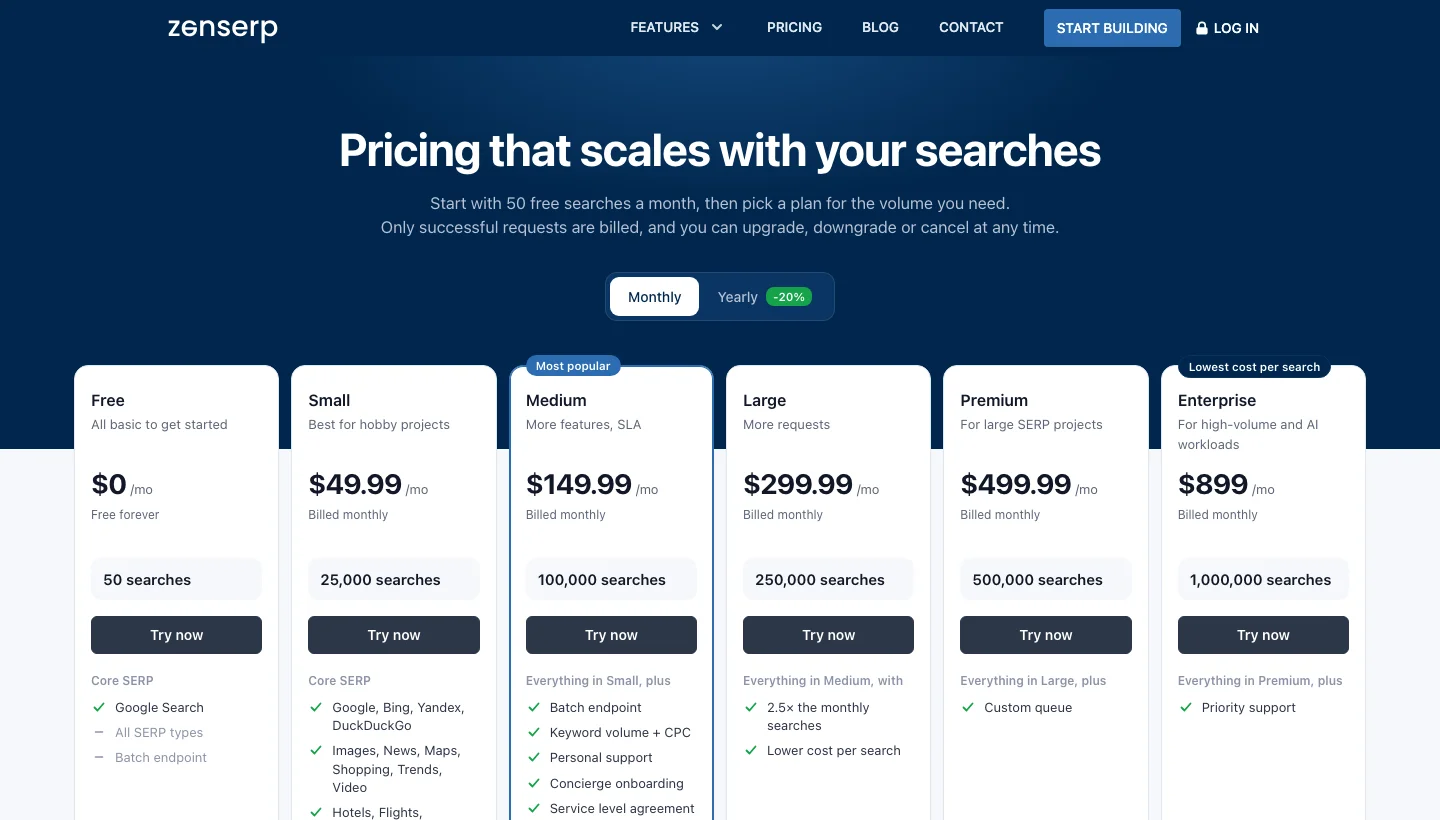
Zenserp bills a monthly search allowance, and only successful requests are billed. Its plans are:
- Free: 50 searches a month.
- Small: $49.99 for 25,000 searches (about $2.00 per 1,000).
- Medium: $149.99 for 100,000 searches ($1.50 per 1,000), the first plan with the batch endpoint.
- Large: $299.99 for 250,000 searches ($1.20 per 1,000).
- Premium: $499.99 for 500,000 searches ($1.00 per 1,000).
- Enterprise: $899 for 1,000,000 searches ($0.90 per 1,000).
An AI Overview request that returns an overview uses three searches, about $6.00 per 1,000 overviews on Small. See Zenserp pricing.
How do you build a rank tracker on a SERP API?
A tracker needs four things on top of a SERP API: a rank counter, a store, a validity check, and a schedule. The steps below use ScraperAPI’s Google SERP API, and the same structure works with any provider that returns organic results.
Step 1: Fetch one page of results
First, call ScraperAPI’s Google SERP API with the keyword, a Google domain, a country, and a start offset. Each call returns up to 10 organic results and costs 25 ScraperAPI credits. The code retries failed calls, and ScraperAPI charges only successful requests.
import os
import sqlite3
from datetime import date

import requests

API_URL = "https://api.scraperapi.com/structured/google/search"
PAGE_SIZE = 10


def fetch_page(keyword, start, country_code="us", retries=3):
    params = {
        "api_key": os.environ["SCRAPERAPI_KEY"],
        "query": keyword,
        "tld": "com",
        "country_code": country_code,
        "hl": "en",
        "start": start,
    }
    for _ in range(retries):
        response = requests.get(API_URL, params=params, timeout=70)
        if response.status_code == 200:
            return response.json()
    return None  # still failing after the retries
Step 2: Count the rank from the organic list
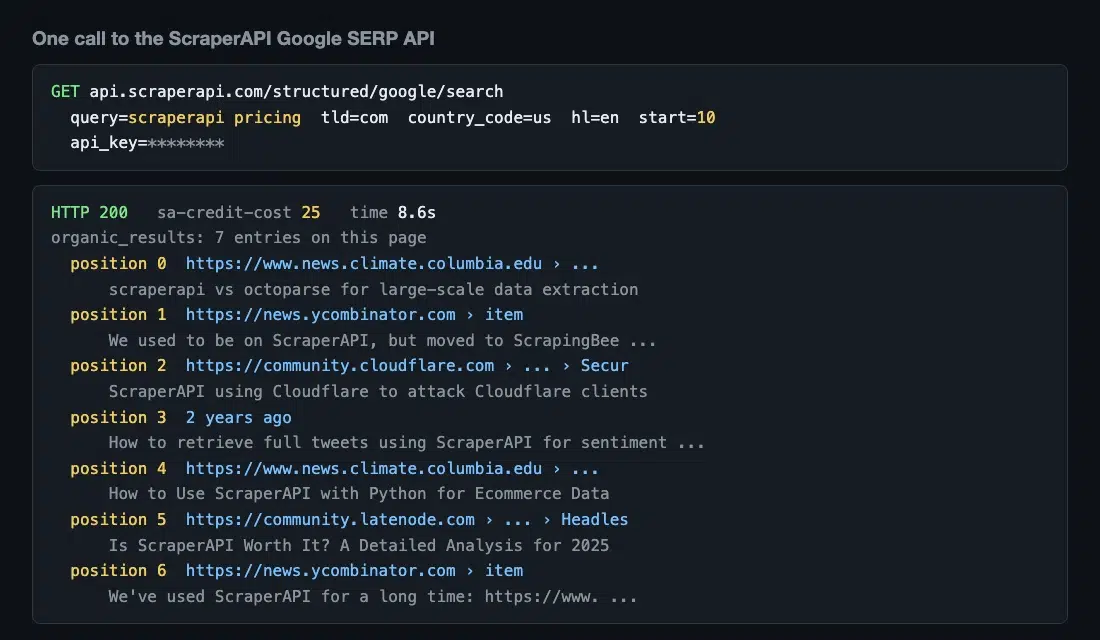
Next, do not read the position field as the organic rank. In ScraperAPI’s Google SERP API it counts every block on the page, so a local pack takes positions 0 to 2 and the first organic result starts at 3, and it restarts at 0 on each page.
One Reddit thread reports the same problem with a rank_absolute style field in another API, where SERP features shift keywords by several places (r/SEO). Instead, count the index inside organic_results, and match your domain on displayed_link, because link is a google.com redirect wrapper on most results.
def find_rank(domain, pages, min_results=30):
    """Return (rank, valid). Rank counts organic results only, across pages."""
    seen = 0
    for data in pages:
        for item in data.get("organic_results", []):
            seen += 1
            if domain in item.get("displayed_link", ""):
                return seen, True
    # Not found: only trust "not ranking" when the SERP was complete.
    return None, seen >= min_results
Step 3: Page through results with start
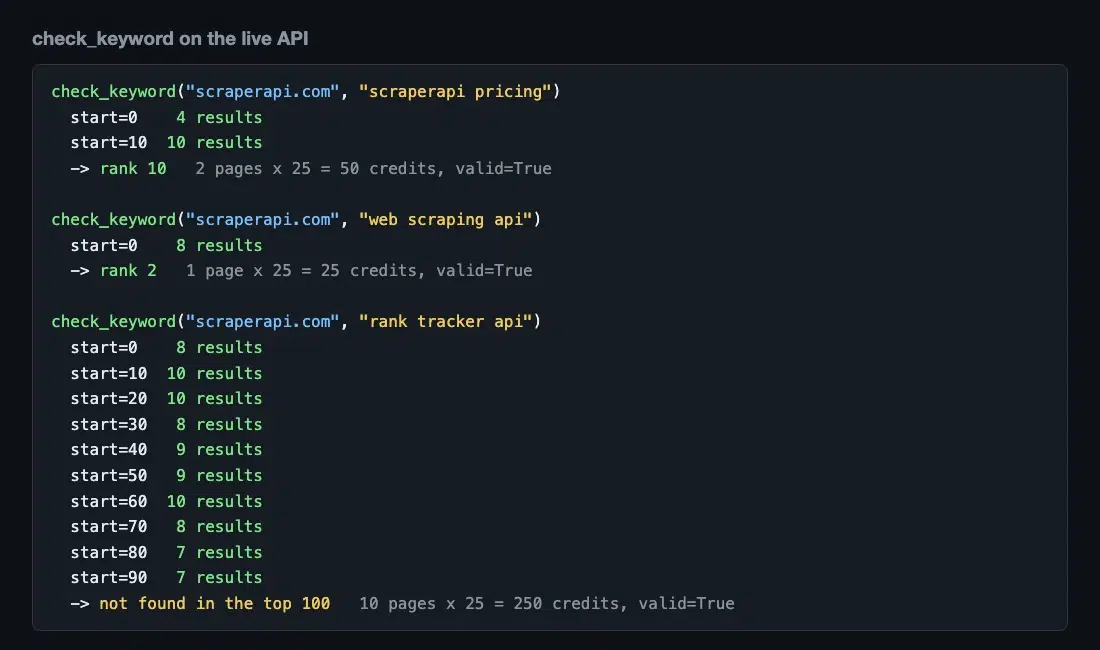
Then request start=0, start=10, and so on, and stop as soon as the domain appears. Each page costs 25 ScraperAPI credits, and the number of organic results per page varies from 4 to 10, and the same query can return different results from one call to the next.
def check_keyword(domain, keyword, max_pages=10, min_results=30):
    pages = []
    for page_number in range(max_pages):
        data = fetch_page(keyword, page_number * PAGE_SIZE)
        if data is None:
            return None, False  # a page that keeps failing makes the check "missing"
        pages.append(data)
        rank, valid = find_rank(domain, pages, min_results=0)
        if rank:
            return rank, True
    return find_rank(domain, pages, min_results)
Step 4: Store the result and keep failures as missing
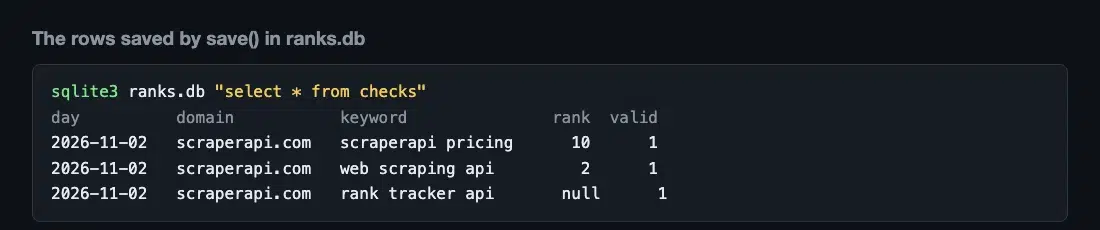
After that, save the keyword, the date, the rank, and a validity flag. A failed or short SERP is a missing observation, and a missing observation is not a drop to “not ranking” (r/localseo).
For a spreadsheet version of the same idea, see ScraperAPI’s guide to scrape keyword rankings into a spreadsheet. Against the live API, the script printed rank tracker api -> not found for scraperapi.com, and rank 1 for scraperapi pricing.
def save(db_path, domain, keyword, rank, valid):
    db = sqlite3.connect(db_path)
    db.execute(
        "CREATE TABLE IF NOT EXISTS checks "
        "(day TEXT, domain TEXT, keyword TEXT, rank INTEGER, valid INTEGER)"
    )
    db.execute(
        "INSERT INTO checks VALUES (?, ?, ?, ?, ?)",
        (date.today().isoformat(), domain, keyword, rank, int(valid)),
    )
    db.commit()
    db.close()


if __name__ == "__main__":
    rank, valid = check_keyword("scraperapi.com", "rank tracker api")
    save("ranks.db", "scraperapi.com", "rank tracker api", rank, valid)
    status = "missing" if (rank is None and not valid) else rank or "not found"
    print(f"rank tracker api -> {status}")
Step 5: Add a canary check
Meanwhile, the min_results argument is the canary. A search that returns fewer than 30 results is treated as incomplete, so a keyword that is not found stays “missing”.
Practitioners also run brand terms daily and discard the day’s data when the brand does not rank first. The helper returns these results on saved responses from ScraperAPI’s Google SERP API:
searlo.tech -> (4, True)
rankability.com -> (16, True)
example.com, complete SERP -> (None, True)
example.com, short SERP -> (None, False)
Step 6: Schedule the checks and compare with Search Console
Finally, run the script daily from cron, or submit the keyword list as batches to ScraperAPI’s Async Scraper or ScraperAPI’s DataPipeline.
Use Search Console as the sanity check for money keywords and the tracker for direction, because providers disagree: in HasData’s benchmark, two live Google searches (one signed in, one signed out) matched on only 16 percent of positions (HasData benchmark, published 22 October 2026, and HasData sells a competing API).
For a monitoring workflow that fetches results at scale, see ScraperAPI’s SERP monitoring tutorial.
Which rank tracking API should you choose?
Choose a platform when you want dashboards and stored history, and choose a SERP API when you are building a product or a custom pipeline. The table maps each situation to one tool and its main trade-off.
| If you are | Choose | Why | Trade-off |
|---|---|---|---|
| An agency that wants a dashboard and an API | SE Ranking, Keyword.com, or AccuRanker | History is stored and billed per tracked keyword. | API calls run on platform plans and keyword limits. |
| A developer building a tracker at the lowest price per SERP | DataForSEO | $0.60 per 1,000 SERPs on the Standard queue. | You build the dashboard and storage. |
| A developer who wants a fixed monthly plan with city-level location | SerpApi | location, uule, and device on every plan. | $275 a month for 1,000 daily keywords. |
| A high-volume collector across several engines | Bright Data SERP API | Four engines, unlimited concurrency, and $1.50 per 1,000 successful requests. | The pricing and documentation need more reading. |
| A developer who wants a general scraping API with a Google SERP endpoint | Scrapingdog | $40 a month on Lite covers 1,000 daily keywords. | Reviews on G2 and Reddit report reliability and support concerns. |
| A team that wants AI Overview text and a batch endpoint in one API | Zenserp | ai_overview=1 and a batch endpoint with webhooks on Medium and above. | An AI Overview request costs three searches. |
| A developer or data team that needs the SERP, scheduling, retries, and delivery from one vendor | ScraperAPI | ScraperAPI’s Google SERP API, Async Scraper, and DataPipeline run together. | ScraperAPI does not store history, and a Google search costs 25 credits. |
| A team that needs Bing, Yahoo, city or ZIP targeting, and AI Overview content | SerpWow by ScraperAPI | engine, device, location, and include_ai_overview parameters. | Billed separately from ScraperAPI, from $38 a month for 1,000 searches. |
| An SEO platform that buys SERP data as cost of goods | Two vendors, one on top | Backup vendors protect a product that depends on the data. | Pick the top slot by reproducibility, not the nicest-looking position. |
If you are building your own tracker, check out ScraperAPI’s SERP API. It returns the results page as JSON, and ScraperAPI’s Async Scraper and DataPipeline handle scheduling and delivery, so the code in this guide runs on it as written.
The 7-day trial includes 5,000 credits with no card, which covers 200 Google searches.
Start your free ScraperAPI trial
Rank tracker API FAQs
What is a rank tracker?
A rank tracker is software that records where a URL appears in search results for a keyword, and how that position changes over time. It checks results on a schedule for a chosen location and device.
A rank tracker API lets other software read or create that data.
What is SERP tracking?
SERP tracking records the full search results page for a keyword, including organic results, ads, local packs, People Also Ask boxes, and AI Overviews. Rank tracking is the part that reads where a site appears.
Most SERP APIs return the whole page, and the tracker picks out the rank.
What is the best rank tracker?
The best rank tracker API depends on who stores the history. SE Ranking, AccuRanker, and Keyword.com store it and bill per tracked keyword, which suits agencies.
DataForSEO, SerpApi, Bright Data, ScraperAPI, SerpWow by ScraperAPI, Scrapingdog, and Zenserp return raw results, which suits teams that build their own tracker.
Which API is the best for SEO?
For rank data, pick on location targeting, output format, and price per 1,000 searches, not on one headline number. DataForSEO is the lowest per SERP at $0.60 per 1,000 on the Standard queue, SerpApi offers city-level location on a fixed plan, and ScraperAPI covers the SERP, scheduling, and delivery from one vendor.
Why do we use SerpApi?
Teams use SerpApi to get Google results as JSON without running proxies, solving CAPTCHAs, or parsing HTML. It accepts a location, a device, and a start offset, and it bills per successful search.
Other SERP APIs in this guide do the same job with different billing units.
Ready to build? Start a free trial with ScraperAPI’s 7-day trial and 5,000 credits, no card needed.