The best Bright Data alternatives depend on which Bright Data product you’re replacing. Oxylabs is the closest full-stack match. Decodo and IPRoyal are cheaper for raw proxy bandwidth. ScraperAPI and Zyte replace the request-based Unlocker and SERP APIs. Apify replaces ready-made scrapers, and SOAX covers mobile proxies at a single rate.
Most comparison pages treat Bright Data as one product and rank their own tool first. This guide maps each Bright Data product to the alternatives that replace it, lists each tool’s billing unit and entry price from its official pricing page, and notes where each option, including ScraperAPI, falls short. Prices checked on 8 October 2026.
TL;DR: The best Bright Data alternative for each Bright Data product
Pick your alternative by the Bright Data product on your invoice, not by a generic ranking. This table is the short version of everything below.
| If you use Bright Data’s | Best alternatives | Why |
|---|---|---|
| Residential proxies | Decodo, IPRoyal, Oxylabs | Lower entry prices: $11.25 to $30 starter plans instead of Bright Data’s $499 monthly plan |
| Mobile proxies | Oxylabs, SOAX, Decodo | All three still sell mobile proxies to new customers |
| Unlocker API (Web Unlocker) | ScraperAPI, Zyte, ScrapingBee | Credit-based or per-response billing; only successful responses are charged |
| SERP API | ScraperAPI, Zyte, ScrapingBee | Parsed Google results as JSON, with country targeting |
| Web Scraper APIs or datasets | Apify, ScraperAPI, Oxylabs | Ready-made scrapers or structured endpoints for sites such as Amazon, Google, ChatGPT, Walmart, eBay, Redfin, and more |
| Crawl API or MCP for AI agents | Firecrawl, ScraperAPI | LLM-ready markdown output |
If you want a cheaper alternative to Bright Data, start with Decodo for proxies and ScraperAPI or ScrapingBee for request-based scraping. For enterprise-scale proxy coverage across every proxy type, we recommend Oxylabs as it is the closest like-for-like replacement.
Why are teams looking for Bright Data alternatives in 2026?
Most teams leave Bright Data because of cost and billing complexity, and 2026 added two new reasons: stricter access to residential proxies and the removal of mobile proxies from its sign-up flow.
Residential proxies now require company KYC. For residential zones created after July 7, 2026, Bright Data grants access only to registered companies that pass a compliance review, and personal email domains aren’t eligible (Bright Data residential network access). If you’re a freelancer, a researcher, or a small team using a personal account, that door is closed. The Unlocker API doesn’t require this review. If you’re new to the proxy types, our guide to residential proxies explains why they’re gated this way.
Mobile proxies are no longer listed. As of September 2026, mobile proxies don’t appear in Bright Data’s proxy pricing or product navigation, and the old mobile pricing page redirects. Bright Data hasn’t published an official announcement that we could find, so treat this as “not available to new sign-ups” rather than a formal shutdown.
Billing is hard to predict. Bright Data sells a dozen metered products, each with its own unit. One user in a 2021 Reddit thread described the same pattern: fast, with unlimited concurrency, but “too pricey” (r/webscraping). Bright Data’s own pricing pages say you pay less per record as you scale, so the rate you see depends on your plan.
How to identify which Bright Data product and billing unit you’re replacing?
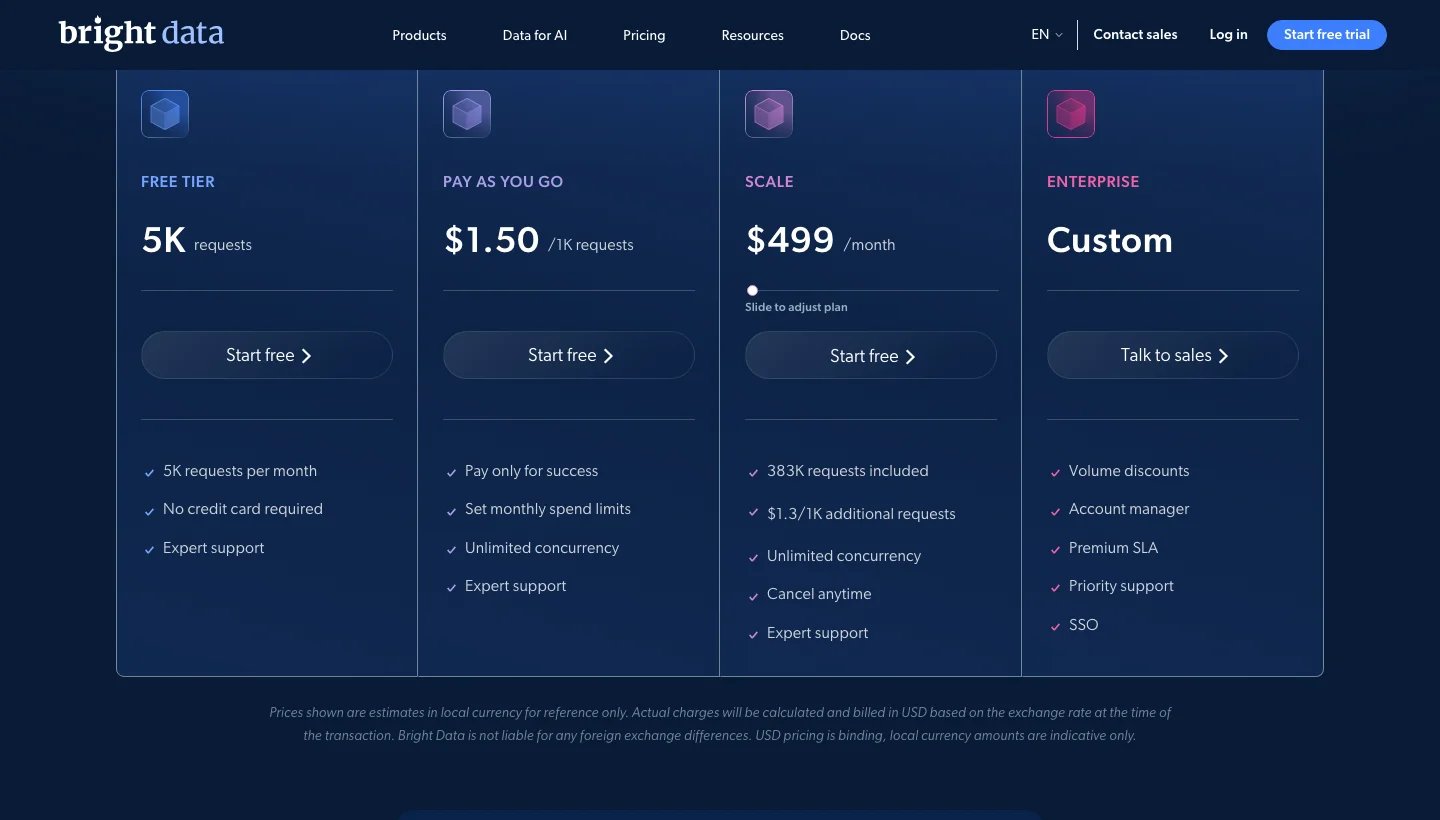
Bright Data bills per GB, per IP, per 1,000 requests, or per 1,000 records depending on the product, so compare alternatives in the same unit you pay today. Here’s what Bright Data lists on its official pricing pages:
| Bright Data product | Billing unit | Pay-as-you-go / entry price |
|---|---|---|
| Residential proxies | per GB | $8/GB; plans from $499/month |
| ISP proxies | per IP | $18/month for 10 IPs |
| Datacenter proxies | per IP or per GB | $14/month for 10 IPs; $0.60/GB |
| Unlocker API (Web Unlocker) | per 1,000 successful requests | $1.50 per 1,000 (pricing) |
| SERP API | per 1,000 successful requests | $1.50 per 1,000 |
| Web Scraper APIs | per 1,000 successful records | $1.50 per 1,000 |
| Browser API (Scraping Browser) | per GB | $8/GB |
| Datasets | per 1,000 successful requests | $2.50 per 1,000; $250 minimum |
Bright Data also offers a free tier of 5,000 requests or records per month.
So someone replacing residential bandwidth and someone replacing the SERP API are shopping in two different markets. The list below tells you which market each alternative serves.
What are the nine best Bright Data alternatives?
These are the nine Bright Data competitors worth evaluating in 2026, ordered by how closely they replace Bright Data. We used the same format for each Bright Data competitor, so you can compare them fairly.
1. Oxylabs: The closest full-stack replacement
Oxylabs is the only alternative that matches Bright Data across nearly every product line: residential, ISP, datacenter, and mobile proxies, plus a Web API, an Agent Browser, Web Unblocker, and datasets.

- Replaces: the full proxy stack, Web API, Web Unblocker, Agent Browser, and datasets.
- Pricing: one subscription covers every product, from $30/month (Starter) to $500/month (Flexible); residential proxies start at $6/GB, mobile proxies at $7.50/GB, and Web API scraping at $0.50 per 1,000 results (Oxylabs pricing).
- Free trial: a one-time $5 welcome credit that works on any product.
- Where it wins: still sells mobile proxies; a $30 starter subscription instead of a $499 plan; a like-for-like product map makes migration straightforward.
- Where it falls short: datasets are sold through sales rather than instant checkout (standard from $400/month, custom from $800/month), and Web API rates vary by target, so JavaScript-heavy pages cost more per 1,000 results.
- Best for: teams that use several Bright Data products and want one vendor to replace them all. For e-commerce specifically, see our Oxylabs alternatives for e-commerce scraping.
2. Decodo (formerly Smartproxy): The budget proxy-plus-API option
Decodo, the rebranded Smartproxy, is the cheapest way to replace Bright Data’s residential proxies while keeping a scraping API in the same account.

- Replaces: residential, ISP, datacenter and mobile proxies; Web Unlocker; Web Scraper API.
- Pricing: residential from $11.25/month for 3 GB ($3.75/GB) or $4/GB pay-as-you-go; Web Scraping API from $19/month for up to 38,000 scraped pages; mobile from $3.75/GB on self-serve plans (Decodo pricing).
- Free trial: 3-day residential trial with 100 MB; a free scraping API plan with up to 10,000 scraped pages a month.
- Where it wins: low entry price and mobile proxies still available.
- Where it falls short: no dataset marketplace, and a smaller advertised pool (115M+ IPs versus Bright Data’s 400M+ claim).
- Best for: small teams that need residential bandwidth without KYC paperwork. Compare it directly in our Smartproxy alternative breakdown.
3. ScraperAPI: Web data infrastructure for replacing Bright Data APIs
ScraperAPI’s web data infrastructure replaces Bright Data’s Unlocker API, SERP API, Scraper APIs, Browser API, Crawl API, and MCP server with one API key and credit-based billing: you send a URL or a query, and you get HTML, markdown or structured JSON back. Proxy rotation, retries, CAPTCHA handling and browser rendering happen on ScraperAPI’s side, and a dedicated team spends 50 percent of its engineering catching new blocks and layout changes and fixing them fast. ScraperAPI is also agent-ready by default, with an MCP server, a CLI, a plugin for AI agents, and integrations for n8n, Zapier, LangChain, and LlamaIndex. For a side-by-side view, see ScraperAPI vs Bright Data.
We tested the three workloads that map to Bright Data’s Unlocker, SERP and Scraper APIs while writing this guide:
- Unlocker-style requests: a plain API call returned a full Indeed job search page (job titles, companies, locations and pagination) for 1 credit, the standard-domain cost.
- SERP API replacement: the Google Search structured endpoint returned parsed JSON with organic results and People Also Ask questions. Adding
country_code=dereturned localised google.de results. Google requests cost 25 credits. - Web Scraper API replacement: the Amazon product endpoint returned price, list price, availability, specifications and star distribution as JSON for 5 credits per request.
Here’s the SERP and Amazon workload in Python:
import requests

API_KEY = "YOUR_API_KEY"

# Replaces Bright Data's SERP API: parsed Google results for Germany
serp = requests.get(
    "https://api.scraperapi.com/structured/google/search",
    params={"api_key": API_KEY, "query": "web scraping api", "country_code": "de"},
    timeout=70,
).json()
for result in serp["organic_results"][:3]:
    print(result["position"], result["title"])

# Replaces Bright Data's Web Scraper API for Amazon: one product as JSON
product = requests.get(
    "https://api.scraperapi.com/structured/amazon/product",
    params={"api_key": API_KEY, "asin": "B08Z6X4NK3", "tld": "com"},
    timeout=70,
).json()
print(product["name"], product["pricing"], product["availability_status"])
- Pricing: Plans range from $49/month (Hobby: 100,000 API credits and 20 concurrent threads) to $1,975/month (Advanced: 21,500,000 credits and 500 concurrent threads) and above, with geotargeting, credits, and concurrent threads growing by tier. Self-serve goes up to $1,975/month before you need to talk to sales, which suits teams that prefer to skip a sales call (ScraperAPI pricing). Credits per request depend on the target: 1 for standard sites, 5 for Amazon, 25 for Google and Bing, and 10 extra for JavaScript rendering.
- Free trial: 7 days with 5,000 API credits and no credit card required, then a free plan with 1,000 credits a month.
- Where it wins: maintenance handled for you, with 50 percent of engineering spent keeping success rates high and fixing blocks and layout changes fast, and the whole pipeline (find, unblock, extract, scale, schedule and send) from one vendor. Billing is credit-based, with no per-GB math, and pay-as-you-go on the Scaling plan and above so your pipeline never stops. Only successful 200 and 404 responses are charged, so failed 500 requests are free. Its structured data endpoints return JSON for Amazon, Google, ChatGPT, Walmart, eBay, Redfin, and more. DataPipeline runs scheduled projects of up to 100,000 URLs, and Async batch jobs take up to 50,000 URLs with automatic retries for up to 24 hours.
- Where it falls short: no standalone proxies, raw per-GB plans, or mobile proxies, so it cannot replace Bright Data’s proxy network; credit costs vary by target (Google is 25 credits, ultra premium is 30), so estimate your mix before choosing a plan; geotargeting is limited to the US and EU on the Hobby and Startup plans (global from Business).
- Best for: developers and data teams replacing Bright Data’s Unlocker, SERP, Scraper, Browser or Crawl APIs who want one vendor to handle blocking, retries and site changes, scaling from a first API call to scheduled production feeds.
4. Zyte: Pay-by-difficulty unblocking plus Scrapy Cloud
Zyte, the company behind Scrapy, prices its Zyte API by how hard each target site is to access, which makes easy sites very cheap and hard sites expensive.

- Replaces: Unlocker API, SERP API, and Browser API.
- Pricing: pay-as-you-go from $0.13 to $1.27 per 1,000 HTTP responses and $1.01 to $16.08 per 1,000 browser-rendered responses across five difficulty tiers; commitment plans from $100/month (Zyte pricing).
- Free trial: $5 in credit for 30 days.
- Where it wins: a very low floor on easy sites, AI extraction that returns typed JSON, and first-class support for Scrapy projects through Scrapy Cloud.
- Where it falls short: no standalone proxy network product (proxy access runs through Zyte API), and because the tier depends on each site, monthly costs are harder to forecast than flat per-request pricing.
- Best for: Scrapy teams with a mix of easy and hard targets. See our Zyte alternative comparison.
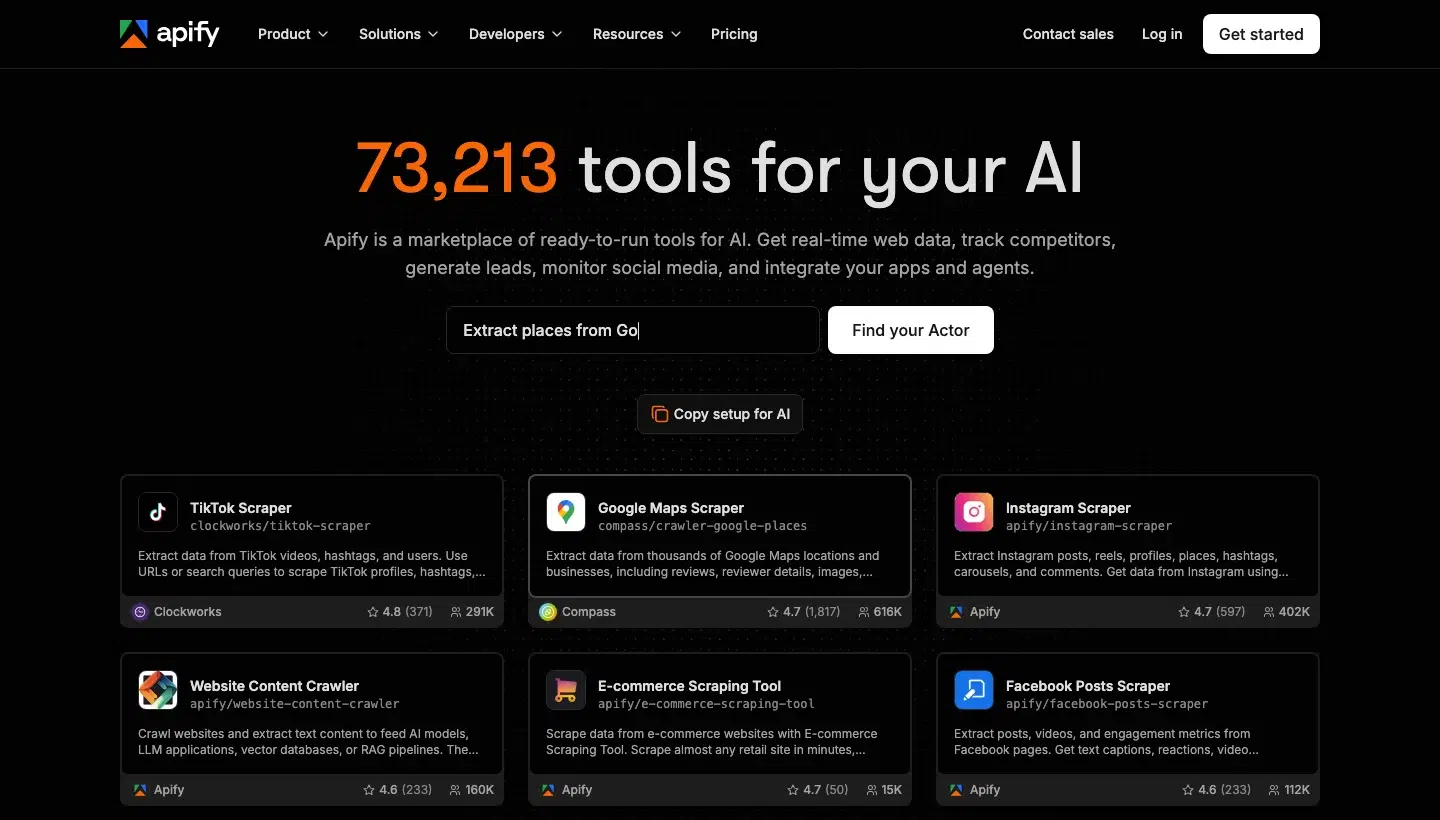
5. Apify: Ready-made scrapers instead of Bright Data’s Scraper APIs
Apify is a scraping and automation platform built around Actors, reusable scrapers you run in Apify’s cloud or publish yourself.
- Replaces: Web Scraper APIs and Scraper Studio, and partly datasets.
- Pricing: Starter $19/month (includes $19 of platform usage); compute units at $0.13 to $0.20; residential proxies at $7 to $8/GB (Apify pricing).
- Free trial: a free plan with $5 of monthly usage and 5 concurrent runs.
- Where it wins: 83,000+ ready-made Actors in the Apify Store, plus hosting and scheduling for your own scrapers.
- Where it falls short: residential bandwidth costs more than Bright Data’s discounted rate, unused credits expire monthly, and Actor quality and pricing vary by developer.
- Best for: teams that want a working scraper for a common site today. Compare Bright Data vs Apify or browse other Apify alternatives.
6. ScrapingBee: Simple API credits for unblocking and Google search
ScrapingBee is a scraping API with straightforward credit plans and a built-in Google Search API.
- Replaces: Unlocker API and SERP API.
- Pricing: Freelance $49/month for 250,000 credits with 50 concurrent requests (ScrapingBee pricing). A request costs 5 credits with JavaScript rendering, 10 with premium proxies, and 25 with both.
- Free trial: 1,000 free credits, no card.
- Where it wins: simple plans, relatively high concurrency on entry tiers, and Google Search plus screenshots included on every plan.
- Where it falls short: no proxy-only, mobile or dataset products, so it can’t replace Bright Data’s proxy network.
- Best for: small projects that need unblocking and search results without managing proxies. See Bright Data vs ScrapingBee.
7. Firecrawl: For AI agents and LLM pipelines
Firecrawl turns web pages into LLM-ready markdown or JSON and is built for AI agents and retrieval pipelines rather than proxy workloads.

- Replaces: Bright Data’s Crawl API and MCP server for AI-agent use cases.
- Pricing: 1 credit per page scraped or crawled; Hobby $16/month billed annually ($19 monthly) for 5,000 credits and 5 concurrent requests (Firecrawl pricing).
- Free trial: a free plan with 1,000 credits per month and 2 concurrent requests.
- Where it wins: clean markdown out of the box, an open-source core, and SOC 2 Type II compliance.
- Where it falls short: no proxy products, no dataset marketplace, and low concurrency on entry plans, which limits large crawls.
- Best for: AI teams feeding web content into LLMs.
8. IPRoyal: Proxies with traffic that never expires
IPRoyal is a proxy-only provider whose main difference is billing: residential traffic you buy never expires.

- Replaces: residential, ISP, datacenter and mobile proxies.
- Pricing: residential from $7/GB, falling to $1.75/GB at 10 TB; ISP from $1.80 per proxy per day; datacenter from $1.39 per proxy; mobile from $10.11 per day; a Web Unblocker from $1 per 1,000 requests (IPRoyal pricing).
- Free trial: no standard free trial; you can test with a 24-hour paid plan (ISP from $1.80, mobile from $10.11).
- Where it wins: non-expiring traffic and no monthly minimum, which suits irregular workloads; mobile proxies are available.
- Where it falls short: a smaller residential pool (64M+), no dataset products, and little beyond proxies and a basic unblocker.
- Best for: bursty or seasonal proxy usage where monthly plans waste money.
9. SOAX: Residential and mobile proxies at one rate
SOAX sells residential and mobile proxies from the same prepaid credit balance, priced by geography tier.

- Replaces: residential and mobile proxies.
- Pricing: Builder plan $200/month for 200 credits, spent at $3/GB in the most expensive geo tier down to $1.20/GB in the cheapest (SOAX pricing).
- Free trial: none; a free Sandbox plan exists but includes no credits.
- Where it wins: one rate for residential and mobile traffic, transparent public pricing, and credits that roll over for 60 days.
- Where it falls short: a $200 minimum, no free trial, generally non-refundable payments, and no ISP or datacenter proxies in the current lineup.
- Best for: teams that lost access to Bright Data’s mobile proxies. See our SOAX alternative page for a comparison.
How do the nine Bright Data alternatives compare?
All nine tools side by side. Prices checked on 8 October 2026, from each vendor’s official pricing page.
| Tool | Replaces Bright Data’s | Billing unit | Entry paid plan | Free trial or tier |
|---|---|---|---|---|
| Oxylabs | Full stack | per GB / per 1,000 results | $30/month (subscription) | $5 welcome credit |
| Decodo | Proxies, Unlocker, Web Scraper API | per GB / per 1,000 requests | $11.25/month (3 GB) | 3-day trial; free scraping plan |
| ScraperAPI | Unlocker, SERP API, Scraper APIs, Browser API, Crawl API, MCP | credits per successful request | $49/month (100,000 credits) | 7 days, 5,000 credits |
| Zyte | Unlocker, SERP API, Browser API | per 1,000 responses, by difficulty | from $100/month commitment | $5 credit |
| Apify | Scraper APIs, Scraper Studio | prepaid usage / compute units | $19/month | $5/month usage |
| ScrapingBee | Unlocker, SERP API | credits per successful request | $49/month (250,000 credits) | 1,000 credits |
| Firecrawl | Crawl API, MCP | credits per page | $16/month (annual) | 1,000 credits |
| IPRoyal | Proxy stack | per GB / per proxy | $7 (1 GB) | none |
| SOAX | Residential + mobile | prepaid credits per GB | $200/month | none |
How to compare cost when the billing units don’t match?
You should compare Bright Data alternatives on cost per successful result, not on the headline price, because a per-GB plan and a per-request plan can look cheap or expensive depending on your pages.
To convert per-GB pricing into a per-page cost, divide the price per GB by the number of pages that fit in a gigabyte. Page weight varies widely (a text-only page might be tens of kilobytes; a JavaScript-heavy product page can be several megabytes), so measure the average response size of your own targets instead of trusting a generic figure. Then compare that per-page cost with per-request pricing.
Next, account for failures. Retries on a per-GB plan still consume bandwidth, while some per-request APIs only bill successful responses. ScraperAPI, for example, charges only for 200 and 404 responses, and its max_cost parameter caps what a single request can cost. Bright Data’s Unlocker API also bills per successful request, so check how each vendor treats failures before comparing.
A simple worked example with list prices would look like this: 100,000 Unlocker requests on Bright Data’s pay-as-you-go rate of $1.50 per 1,000 cost $150. The same volume of standard-domain requests fits in ScraperAPI’s $49 Hobby plan at 1 credit each, but the same volume of Google requests at 25 credits each would need a larger plan. The right answer depends on your target mix.
The only reliable test is your own workload: run the same job on two or three candidates for a week and compare success rate, latency, and cost per successful result. For a broader framework, see our guide to web scraping pricing.
How to switch from Bright Data without breaking your pipeline?
We recommend switching one workload at a time and keeping Bright Data running as a fallback until the new provider proves itself.
- Inventory what you use. List every Bright Data zone and product, with monthly volume in its billing unit (GB, IPs, requests or records).
- Shortlist two or three alternatives for each product. Account for the pricing, the product, and your team size.
- Run a parallel test on free trials, using one real workload and the same URLs on each provider.
- Compare the numbers that matter: success rate, median latency, and cost per successful result. If you want to learn more about scraping metrics and rates, see our guide on web scraping success rates.
- Cut over gradually. Move one workload, monitor it for a full billing cycle, then move the next. If you scrape Amazon, our guide to Bright Data alternatives for Amazon scraping covers that workload in detail.
How to choose the right Bright Data alternative?
There’s no single best Bright Data alternative, only the best match for the Bright Data product you’re replacing. Oxylabs covers the full stack, Decodo and IPRoyal are cheaper for proxy bandwidth, SOAX fills the mobile gap, Apify gives you ready-made scrapers, and Firecrawl serves AI pipelines.
If your Bright Data bill is mostly Unlocker, SERP API or Web Scraper API requests, ScraperAPI is worth a test run: start the 7-day free trial with your real target URLs and compare cost per successful result against what you pay today.
Frequently Asked Questions
What is Bright Data?
Bright Data is a web data company that sells proxy networks (residential, ISP and datacenter), request-based scraping APIs such as its Unlocker API and SERP API, a browser API, and pre-collected datasets. Each product is billed separately, per GB, per IP, per 1,000 requests, or per 1,000 records.
Who are Bright Data’s competitors?
Bright Data’s main competitors are Oxylabs, Decodo (formerly Smartproxy), ScraperAPI, Zyte, Apify, ScrapingBee, Firecrawl, IPRoyal, and SOAX. Oxylabs competes across the full product line, while the others each replace specific Bright Data products such as proxies, the Unlocker API, or ready-made scrapers.
Which is better, Bright Data or Oxylabs?
Oxylabs is the better choice if you need mobile proxies or want a lower residential entry price, since it still sells mobile proxies and starts at $30/month on a single subscription. Bright Data is broader, with a self-serve dataset marketplace and more product types. For most proxy-plus-API workloads, the two are close enough that price and support should decide.
What are some good alternatives to Bright Data proxies?
For residential proxies, Decodo and IPRoyal offer lower entry prices per GB, and Oxylabs offers the most complete like-for-like replacement. For mobile proxies, which Bright Data no longer lists for new sign-ups, Oxylabs, SOAX and Decodo still sell them.
How much does Bright Data cost?
Bright Data’s pay-as-you-go prices start at $8/GB for residential proxies and $1.50 per 1,000 requests for its Unlocker API and SERP API, with monthly plans starting at $499. Datasets cost $2.50 per 1,000 records with a $250 minimum (prices as of September 2026).
Is Bright Data free?
Bright Data isn’t free, but it offers a free tier of 5,000 requests or records per month. Proxy networks are paid, and new residential access requires company verification.
Is Bright Data trustworthy?
Bright Data is an established provider with a public compliance process, including KYC review for residential proxy access. In May 2024, a judge dismissed X Corp.’s scraping claims against Bright Data (CNBC). The more common complaints are about pricing and billing complexity, not legitimacy.